Brahms’ Fourth Symphony
Full programme
- Nina Shekhar, Lumina (11mins)
- Strauss, Four Last Songs (25mins)
- Brahms, Symphony No.4 (38mins)
Performers
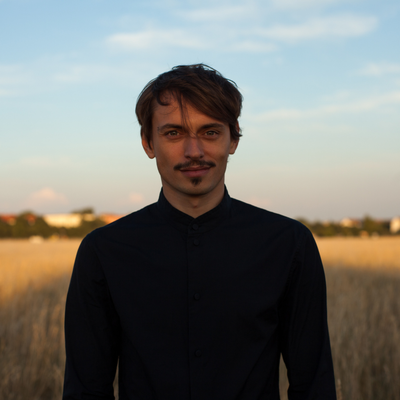
Eduardo Strausser
Conductor
Natalya Romaniw
Soprano
Introduction
This programme invites us to think of music not as a sequence of pieces, but as a way of being in time.
Across more than a century of musical languages, it traces how sound can hold light, memory, and meaning without ever needing to explain itself. The music here becomes a place where clarity and uncertainty coexist: where repetition is not stagnation but persistence, where endings are not failures but transformations, and where beauty is never an escape from reality, but a way of facing it honestly.
In an age that rewards speed, certainty, and instant resolution, the music in this concert insists on something quietly subversive – attention, patience, and trust in the audience’s capacity to listen deeply. It reminds us that complexity doesn’t need to be aggressive, that emotion can be both unsentimental and generous, and that the past is not something we outgrow but something we continually renegotiate.
If there is a message for our present moment, it may be this: that meaning is not always invented anew, nor simply inherited, but shaped slowly, collectively, and with care – one sound at a time.
I hope you will join me in enjoying the music in this way during today's concert.
Eduardo Strausser
Conductor
Programme Notes
Experience the light, the dark and the mysterious middle-ground in this gloriously rich programme, led by the versatile Eduardo Strasser. Shekhar’s Lumina explores a vibrant world of contrasts, or as she puts it, ‘bursts of radiance amongst the eeriness of shadows’. Strauss looks back on his long creative life in Four Last Songs, its seasons and sunsets filtered through his adoration of the soprano voice. The incomparable Natalya Romaniw is the soloist. And despite Brahms subtitling his final symphony ‘Tragic’, it is full of warm orchestral colours. ‘This piece does not altogether displease me’, said Brahms, somewhat modestly. Hard not to agree.
Lumina
Nina Shekhar (b. 1995)
In her own programme note to Lumina (2020), Nina Shekhar describes the piece as ‘explor[ing] the spectrum of light and dark and the murkiness in between’ adding that ‘the piece captures sudden bursts of radiance amongst the eeriness of shadows.’ As you might imagine from this evocative description, Lumina is constructed around contrasts of texture and gesture. It builds from minimal forces – solo violin and vibraphone, played with a bow – to a giant slab of orchestral sound, before receding once more. An interval of a falling third, played by the solo violin at the start, is a kind of anchor point throughout – perhaps suggesting those ‘bursts of radiance’ which get periodically obscured by shadows or ‘murkiness’. A central section of bubbling woodwind and solo violin is interrupted by harshly plucked strings, then surges towards a remarkable peak for full ensemble, complete with groaning, thudding brass. Yet the falling third still manages to shine through this darkly forbidding wall of sound. The music ends with a return to the minimalism of the start: flute and clarinet sliding over a glittering surface of strings.
Four Last Songs
Richard Strauss (1864-1949)
Strauss wrote his Four Last Songs in 1948, aged 84, and he died in September the following year, having never heard them in performance. The texts, by Herman Hesse and Joseph von Eichendorff, are meditations on death and its inevitability, but in a spirit of acceptance rather than dread. The songs are romantically and lushly scored, and therefore somewhat at odds with other new works created in this period. Many composers by this time were abandoning traditional harmony, or experimenting with electronics. By contrast, Strauss’s ‘swansong’ is a full-blooded statement of his love of orchestral colour and the power of the soprano voice.
This voice soars over the orchestral texture in the first song which, though titled ‘Frühling’ (Spring), is considerably more autumnal than most ‘spring-like’ songs, with its rich texture and sober reflection on the passing of time. ‘September,’ by contrast, opens with an uplifting, fanfare-like motif although it mellows at the end into a melancholy horn theme and a gentle rocking figure, embodying the poem’s sense of weariness. The words of the third song (‘Beim Schlafengehen’, or ‘Upon going to sleep’) also suggest an atmosphere of fatigue, yet the music has passages of almost transcendent lyricism, with both solo violin and voice (and later French horn) climbing perpetually upwards, defying the heaviness of the text. The image of the elderly couple contemplating both a sunset and the end of their lives together in ‘Im Abendrot’ perhaps struck a chord with Strauss, who had been married to his wife Paulina – a former professional soprano - since 1894. Its slow-moving, reflective quality, as the text contemplates finality, segues into an extraordinary moment of looking back: the violas quote a theme from Strauss’s tone poem Death and Transfiguration, composed sixty years earlier.
Symphony No.4
Johannes Brahms (1833-1897)
Brahms’ final symphony, composed in 1885, is one of his most well-known and well-loved works (the classical music website Bachtrack lists 38 forthcoming performances of it in 2026 alone). It is warmly regarded for its recognisable motifs – such as its opening rise-and-fall melody, and the elegance of the second movement’s main theme. Yet early detractors of the work felt the Symphony was disastrously lacking in musical invention. The New York Post bluntly described Brahms’s ‘besetting sin’ in this work as a ‘profuse lack of ideas’; while the neighbouring Musical Courier declared that the Symphony had ‘little to commend to the attention of a music-loving public’. Even Brahms’ friends and champions had their doubts. His biographer Edward Hanslick, after hearing a piano-duet version of the work, commented ‘I feel I’ve just been beaten up by two terribly intelligent people’.
What might have bothered the early critics was that Brahms conjured up an entire Symphony based around such minimal means; tiny ‘cells’ of music, rather than grandly flowing melodies. The themes noted above, as well the main musical idea in the finale, are foundational, and subject to variations and continuous development throughout each movement. To early listeners this practice seems to have suggested either a profound lack of imagination, or a drily academic exercise – or both. By contrast, to most contemporary listeners, the result is an emotionally coherent work of such richness that its intensity can be bruising. The Symphony makes a telling appearance in Terence Malik’s film Tree of Life (2011), expressing the domineering father’s otherwise repressed emotional life during an uneasy family dinner. Indeed, the Symphony is not necessarily a ‘comfortable’ listen, with less of the easy grace of Brahms’ previous symphony, the jewel-like no.3. As Tom Service suggested in a Guardian article, this music in no.4 is ‘some of the darkest and deepest in the 19th century’.
The Symphony begins with the fall of a third, followed by the rise of a sixth. The rest of the movement is infused with either thirds or a rise-and-fall sequence. Once you notice them, you will hear them everywhere, and it is to Brahms’ credit that it doesn’t render the music repetitive or banal, but gives it tremendous lyrical momentum. The opening pattern –resembling a sigh – leads quickly to a surging response in the strings, as if the music simply can’t wait to get going. A later, more emphatic theme is also constructed around the interval of a third, yet put to the service of a noble fanfare. At other times, Brahms appears to meditate more broodingly on his thematic material, with passages ranging from stormy to increasingly edgy. The stern conclusion to this movement foreshadows that of the finale.
The second movement opens with a soft horn call, to which the woodwind gently responds. The clarinets expand on the theme, underscored by plucked strings – resembling a guitar accompanying a song. The melody has a melancholy, somewhat ceremonial quality, like a slow march, yet scored with the utmost delicacy. A passage towards the end of the movement, in which the string section shimmers atmospherically under fragments of the opening melody in the winds, appears to look forward to the magical orchestration of Ravel. The brief third movement is relatively breezy, though a few minutes in the boisterous, stomping melody is interrupted by a series of declamatory blasts, followed by an agitated passage in a minor key. The movement ends, however, with a jaunty series of chords, plus some sparkle from the triangle.
The finale is a completely different matter. It opens with ominously building chords, a rumble of timpani, and a general sense of foreboding. The principal theme, outlined in the first bars, is from a chaconne by Bach, and takes on the form of a ‘passacaglia’: the eight bars are repeated 30 times, across different instrumentation, and different configurations. It is as if each section of the orchestra is ‘remembering’ the theme differently, and putting their own interpretation on it; these ‘memories’ range from beautifully meditative to alarmingly violent. The pattern only breaks in the last minute, when the tempo increases, and the whole ensemble gallops towards a ferocious, uncompromising conclusion. Brahms’ final statement in symphonic form does not exactly offer a warm hug. But in its bleakly cathartic moments, it is perhaps the perfect Symphony for ‘dark and deep’ times.
© Lucy Walker
Featured image © Hannah Fathers