Britten & Elgar
Full programme
- Thomas Adès, Powder Her Face: Hotel Suite (18mins)
- Britten, Double Concerto for Violin and Viola (25mins)
- Elgar, Symphony No.1 (50mins)
Performers
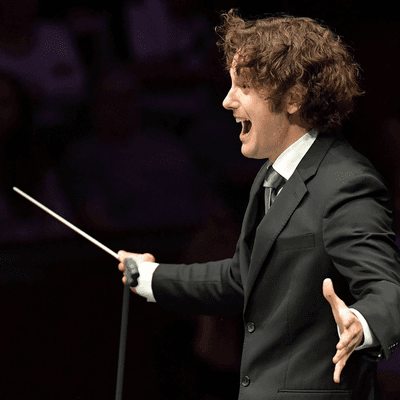
Nicholas Collon
Conductor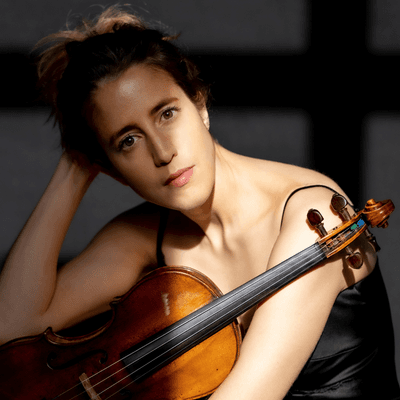
Vilde Frang
Violin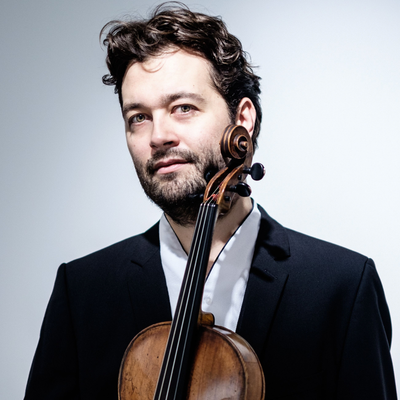
Lawrence Power
Viola
Introduction
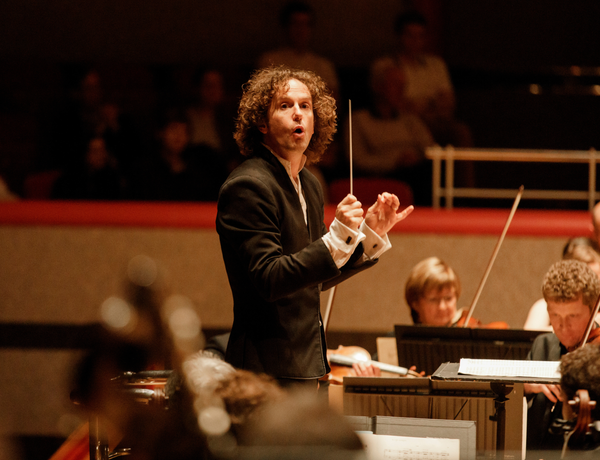
I’ve been coming to conduct the City of Birmingham Symphony Orchestra for nearly 15 years now. I love travelling up to Birmingham and performing in the fabulous Symphony Hall with an orchestra that has so much energy and brilliance. This concert is a fantastic programme and I’ve been greatly looking forward to it.
I’ve worked a lot with Lawrence Power and Vilde Frang as individuals but never together. It will be my first time conducting the Britten Double Concerto for Violin and Viola – it’s a super interesting early work of Britten’s and I’m really intrigued to do it. It’s really nice to get to work with two soloists as they bring totally different energies to the music. I think Lawrence and Vilde are two of the most amazing instrumentalists that exist on this planet.
I’ve conducted Adès’ Hotel Suite a number of times and have also recorded it with the Finnish Radio Symphony Orchestra. It’s a wonderful collection of dances from his opera Powder Her Face and a brilliant showpiece for orchestra. It shows off Adès’ incredible technical mastery and the fun he can have with an orchestra. I think Adès is one of the most genius composers and has written some of the best contemporary music of our time; he’s got this brilliant ability to create music that is highly complex and intellectual whilst being very accessible and fun to listen to.
We finish the concert with one of my favourites: Elgar’s First Symphony. I’ve conducted it many times and I think it’s an absolute masterpiece. I adore the way the second and third movement are connected; the violins’ fast, scurrying theme in the second movement slowly winds down, doubling in value until it becomes slower and slower, transforming into the theme of the third. It is so magical and touching – typical writing of Elgar. The slower movements in Elgar’s works often have a lot of pain behind them but in this symphony, there is more an overall feeling of nostalgia and it’s utterly ravishing. Then, of course, the piece ends in a thrilling, barnstorming finale. Written in 1908, it is a great English Symphony and a complete contrast to the suite by Adès, representing the breadth of English music 100 years apart.
It’s a delight to be back in Birmingham and I am greatly looking forward to seeing the audience again.
Nicholas Collon
Conductor
Programme notes
Prepare yourself to be thrilled and exhilarated by this programme of British music, spanning nearly 100 years and conducted with customary style by Nicholas Collon. Thomas Adès’s Hotel Suite: Powder Her Face finds a Duchess looking back on her life, lusts and memories of dancing the night away. Britten was in his ‘boy genius’ phase when he wrote his Double Concerto: it crackles with youthful energy in the hands of the brilliant soloists, Vilde Frang and Lawrence Power. Elgar’s first symphony is as passionate as it is noble, imbued with what Elgar called ‘massive hope for the future’.
Powder Her Face: Hotel Suite
Thomas Adès (b. 1971)
Adès’s opera Powder Her Face (1995) is based on the life of Margaret, Duchess of Argyll. The narrative moves back in forth in time, in a slightly different chronological framework to that of the real Duchess: we see her meeting her future husband (the Duke) in the 1930s, their divorce in the 1950s which destroyed her reputation – and sold countless newspapers – and her later years in the 1990s, unable to pay her bills in a hotel. The music draws on an eclectic range of styles, from Stravinsky to the tangos of Piazzolla, reflecting the story’s time-travelling structure, as well as its cocktail-and-jazz-bar aesthetic. The orchestration adds to the mood, with saxophones and full drum kits. Hotel Suite is extracted from the opera and outlines, in abbreviated form, the trajectory of the Duchess’s life: from swaggering, jewel-encrusted beginnings to impoverished, messy end.
The Overture opens with a bang, or rather a snarl: the orchestra grabs the listener by the scruff of the neck before segueing into a queasy, sleazy tango. In ‘Scene with Song’ melodic lines are initially subjected to orchestral heckling and raspberry-blowing before settling down into a ‘song’ (in the opera, played as if on the gramophone) lightly accessorised by Charleston rhythms. The somewhat ominous close to this number is the moment when the Duke and Duchess first meet. The ‘Wedding March’ is not a celebration, but a dirge. Mournful sliding figures repeat over grinding bass lines and sinister thuds from the percussion. A spiky ‘Waltz’ follows; in the opera, it is a scene where a Waitress reflects sarcastically on the Duchess’s limitless wealth, and her abject misery. The ‘Finale’ is the opera’s ‘ghost epilogue’. The Duchess is broken and thrown out of her hotel. Fragments of dance music flit across the score, cruelly conjuring up the painful echoes of her life.
Double Concerto for Violin and Viola
Benjamin Britten (1913-1976)
It is not entirely clear why Britten wrote his Double Concerto in 1932 nor why he abandoned it before preparing the score (it was fully orchestrated by Colin Matthews in 1997). He had most likely intended it as a vehicle for himself, on viola, and violinist Remo Lauricella for whom he had already written several pieces. But his abandonment of it was probably that he simply didn’t like it. It was a student piece (Britten was at the Royal College of Music at the time and aged only 18) and his diaries record his somewhat lugubrious self-criticism, noting in May 1932 ‘I expect I shall scrap it all.’ Yet the Concerto bristles with confidence and expressiveness, and demonstrates the kind of distinctive instrumental writing (especially for timpani and horn) that he would retain and develop throughout his career.
The first movement opens with shuddering chords over which a solo horn plays an assertive fanfare. The soloists enter and gradually take on the fanfares, which later travel to the trumpet and the timpani. The theme slows down in a more expressive, almost romantic central section, the luscious scoring of which appears to lull itself briefly to sleep. After reviving with a brief burst of energy, the movement ends quietly. The second movement - a ‘Rhapsody’ - opens in surprisingly dark territory, with mysterious, organ-like chords. After extended solo passages for violin and viola and chamber ensemble the strings begin to march, their relentless quavers gathering in force and intensity. Like the other two movements the Rhapsody ends quietly, the chords from the beginning lingering into the start of the third movement.
While the Rhapsody was dominated by quavers, the finale is a celebration of repeated semiquavers, first heard on the timpani and given a somewhat military flavour by hard, side-drum sticks. Against this insistent background is a catchy, brilliantly syncopated section for the soloists. Heroically double-stopping at times, they launch themselves into this rhythm, or join the timpani for frantic semiquavers. The music builds, then reduces down to an atmospherically chamber-like section and a return of the first movement’s fanfares. The closing passage is exquisite: soft chords, sinuous melodies from the soloists, and a hushed conclusion.
Symphony No.1
Edward Elgar (1857-1934)
Elgar’s first Symphony was a huge success at its premiere, played repeatedly in the years that followed, and remains admired and frequently performed today. Hans Richter, who conducted the Manchester premiere in 1908, declared it ‘the greatest Symphony of modern times’ while the Musical Times noted its ‘immediate and phenomenal success’, as well as its impressive roster of forthcoming international performances. Elgar must have been thrilled, perhaps especially given its lengthy and tricky gestation. He had been considering a symphony since around 1898. Festivals and concert promoters impatiently waited for him to produce something, but – as Michael Kennedy put it – ‘Elgar would not be hurried’. Part of the reason was his anxiety that, in the early twentieth century, the symphony had become an outdated form. Richard Strauss, whom Elgar greatly admired, was favouring ‘symphonic poems’, works with dramatic or philosophical ‘programmes’, while other contemporaries were abandoning the symphony completely.
Nonetheless, Elgar persisted and, while his Symphony does not have ‘programme’, there is a protagonist of sorts in the shape of his opening theme. Appearing after an atmospheric timpani rumble, it is a substantial, noble march with the character of a procession. The theme later turns up briefly on the horns – but is quickly derailed by a tempo change. At the end of the movement, it creeps stealthily into the orchestral texture, scored initially only for the back rows of each string section, and largely covered by busy activity elsewhere. In between are a number of other themes, including a sweet, sighing melody on the strings, and many examples of Elgar’s command of the orchestra: large-scale tuttis (passages for full orchestra) alternate with the most delicate of scoring – for harp and solo violin and cello for example – or abrupt, even aggressive intrusions from the brass. The playing out of the principal theme against this sometimes turbulent backdrop suggests some kind of dramatic scenario (the theme reappears triumphantly in the finale). Yet Elgar stated firmly ‘There is no programme beyond a wide experience of human life with a great charity (love) and a massive hope in the future’.
The two middle movements also revel in thematic journeys. The Allegro molto is whirling and restless; its bustling opening figure will be heard, entirely transformed, in the Adagio. Like the first movement, the Allegro is bursting with melodies, including marches, and a serenely lyrical passage that Elgar instructed the orchestra to play like ‘something you hear down by the river’. This passage recurs towards the end, leading to a melancholy deceleration, before finally landing on a series of suspenseful, held notes. The Adagio opens with a much slowed-down version of the Allegro’s opening figure. The sumptuous harmonies and wistful melodies combine to powerful effect in one of Elgar’s most heartfelt and touching passages of music.
The finale opens slowly, with the atmosphere of a dream; a kind of melange of reminiscences and half-themes. The tempo quickens into agitation, with further themes piling in after one another. The movement also includes, however, a magically expanded version of one of its march themes, converted into luxurious, soaring melodic lines. A spectral variation on the first movement’s theme hovers in the background at one point, but it is not until the closing moments that it makes its full – and full-blooded – return. The entire ensemble takes part, orchestral voices overlapping with one another to glorious, celebratory effect; embodying, perhaps, the ‘massive’ in Elgar’s hope for the future.
© Lucy Walker
Featured image © Andrew Fox