CBSO Benevolent Fund Concert
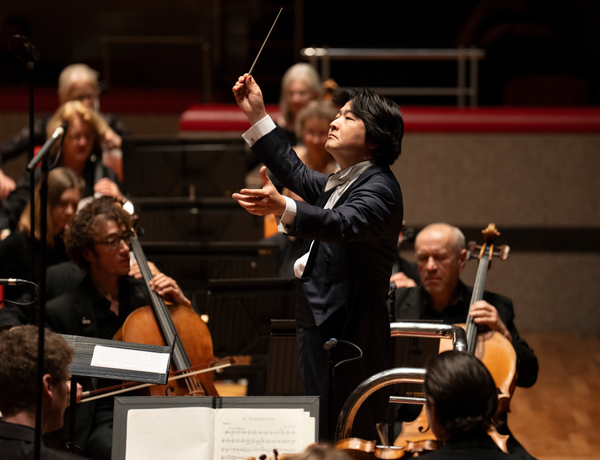
Full programme
- Berlioz, Roman Carnival Overture (10mins)
- Mozart, Piano Concerto No.23 (26mins)
- Rimsky-Korsakov, Scheherazade (47mins)
Performers
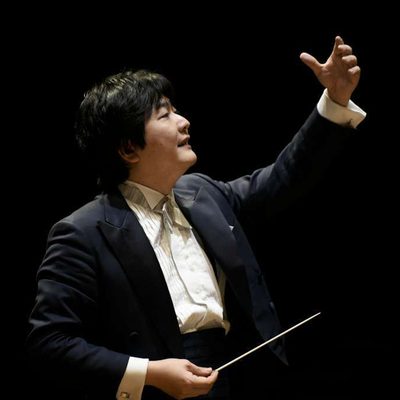
Kazuki Yamada
Conductor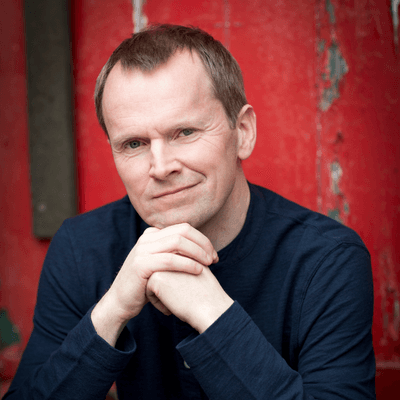
Steven Osborne
Piano
Introduction
Dear Friends and Supporters,
Welcome to the annual fundraising concert for the CBSO Benevolent Fund.
A warm welcome to our annual celebration of the players and staff of the CBSO, past and present. You have come to a unique concert in our season when everyone you see, on stage and off, including our conductor and soloist, put on this concert completely free of charge. All profits from this event go back into the CBSO Benevolent Fund, to continue to help our members remain happy and healthy at work.
Tonight, we are thrilled to welcome back our dear friend Steven Osborne to play Mozart’s Piano Concerto No.23, alongside our wonderful Music Director Kazuki Yamada. We convey our deepest thanks to them both for donating their time and efforts to provide this fundraising opportunity, which allows us to continue to support our members.
It is often said that musicians are like athletes - they have spent hours honing their craft, and routinely use specific movements in an incredibly high-pressure environment. 75% of professional musicians will be injured at some point during their careers, due to a variety of factors. The CBSO Benevolent Fund was set up to provide financial help and support for our active and honorary members in times of need.
Our services contribute towards treatments and therapies, bereavement relief and support for those on long-term sick leave. We also collaborate with the CBSO to run the Fitness to Work Scheme, to tackle the pervading culture of crisis-care in our industry, and ensure employees of the CBSO get regular access to preventative care. We do this by bringing in specialist practitioners around our schedule, including on tour, and programming a season of workshops with experts to widen our knowledge about our bodies and minds.
The CBSO Benevolent Fund is beholden to the generosity of our donors, and the Committee would like to thank everyone who has donated to the Fund since our last concert. In particular, the Justham Family, the Muntz Trust, The Musicians' Union and Mr & Mrs McDermott, whose generosity has been hugely beneficial and deeply appreciated.
The Fund invests all monies received from subscriptions, donations and profits from our annual concert to ensure we’re there for our members. Should you wish to make a further donation - either in the form of a deed of covenant, regular standing order, or a legacy - please write to: The Treasurer, CBSO Benevolent Fund, CBSO Centre, Berkley Street, Birmingham B1 2LF.
Further details on how to donate can be found at www.cbsobenfund.org.uk
We wish you a thoroughly enjoyable concert.
Thank you
On behalf of all our members, The Benevolent Fund Committee would like to sincerely thank our dear friends Kazuki Yamada and Steven Osborne for giving their time and musical joy for this evening’s concert. We recognise their generosity in giving their services free of charge and ensuring that our concert will be a great success. Alongside the wonderful assistance of the CBSO management and staff of Symphony Hall, we know it will be a very special occasion.
On behalf of all the players, we would also like to thank the Fund’s Medical Adviser, Dr Chris Boyson, for his medical support and advice throughout this year. Our thanks go too to our physiotherapy consultant, Sarah UpJohn, whose expertise and advice continues to enable our Fitness to Work Scheme to flourish. We’re eternally grateful to our sports massage therapists Alison Hunt and Ben Levine, and another of our physiotherapists, Kiran Franklin, whose combined knowledge and treatments have greatly improved the working lives of our players and staff.
We must thank our wonderful Trustees: Sangeeta Ambegaokar, Jane Clarke, Robin Daniels, Steven Christie and Jon Lloyd, who have brought their wide-ranging expertise, wisdom and support to successfully run the Fund for another year.
Thanks also go to our financial managers Jennifer Crowley at Cazenove and Laura Hobbs at Rathbone Greenbank for their help towards fulfilling our financial objectives, together with our accountant John Taheny
of Bissell & Brown, and our legal adviser Nick Makin.
Finally, our Committee are all volunteers who give their free time to maintain the operations of the Fund. Our most recent line-up includes Vice-Chair Nathan Isaac, Treasurer Matt Hardy, Secretary Katherine Thomas and Medical Co-ordinator Rachael Pankhurst. The running of the Fund is a big commitment and responsibility, which they meet with energy and generosity. They are a fantastic team of people and I am personally grateful to each of them for their dedication and commitment to our members.
Fitness to Work Scheme. Can you help us?
We know that the UK creative industries are far behind the curve when it comes to health and wellbeing in the workplace. For too long it has been left to ‘crisis’ care, where many musicians live with long-term tension and pain when they play, some crashing out of the industry far too young with long recovery times. Much like a professional athlete, we must put our bodies through intense training, but unlike professional athletes we struggle to afford to look after them.
However, the CBSO is fast becoming an industry-leader in this area. In 2023, the company collaborated with the CSBO Benevolent Fund to help put health and wellbeing central to the company's core values. The Fitness to Work Scheme was devised to tackle this damagingly embedded culture of normalising exhaustion and injury in the pursuit of excellence. Now, we provide regular free specialist treatment, better access to knowledge about our bodies and minds, and work to improve available data on our experiences to strengthen health and wellbeing policy.
Already we feel the benefits of what we have achieved - including happier musicians, relief from stress and injury, and better working relationships across the company. We are proud to work with some of the best practitioners in and around Birmingham: sports massage therapists, physiotherapists, counsellors, performance coaches and breathing experts, to name but a few.
With the available arts funding worsening year on year, the CBSO will struggle to continue to fund a project like this. This scheme costs around £25k a year, with the majority of funding coming from the Benevolent Fund.
If you would be interested in helping the CBSO fund the Fitness to Work Scheme, or know of funding sources we should be aware of, please get in touch with us by email at development@cbso.co.uk or call 0121 616 6500.
Georgia Hannant
Chair of the Committee, CBSO Benevolent Fund
Programme Notes
Rimsky-Korsakov's Scheherezade is brimming with sweeping melodies, lush orchestration and colourful textures. Kazuki and Steven Osborne join forces for Mozart's Piano Concerto No.23 after a performance of Berlioz's exhilarating Roman Carnival Overture.
Roman Carnival Overture
Hector Berlioz (1803-1869)
In 1838 Berlioz composed Benvenuto Cellini, an opera based (very loosely) on the life of a Florentine sculptor. It was an almighty flop. According to the composer, it was ‘hissed with admirable energy and unanimity’ at its premiere and Berlioz found the wholesale rejection of his opera similar to being ‘stretched on the rack’. He had, optimistically, composed a new second-act overture for what he believed would be the likely revival of Benvenuto; when that did not happen, he presented it as the concert overture Roman Carnival in 1844, recycling several melodies from the opera, including the beautiful ‘love’ theme adapted for the cor anglais. As Herbert Glass once put it, ‘Berlioz, like the better French chefs, never threw anything away’.
The Overture begins with an attention-grabbing burst before making space for the cor anglais theme. After reaching a romantic peak, a sparkling whirl from the woodwind reintroduces a faster pace, and a breathless sense of anticipation: this is the ‘carnival’ section from the opera. It builds dramatically, with crashing interjections from the full percussion section, only to reduce abruptly to a whisper of woodwind. This is followed by a feverish fugue, a rising figure played by different instruments in turn. The Overture continues in this spirited vein, threatening to come completely off the rails by the end. Berlioz, like the better French composers, never played by the rules.
Piano Concerto No.23
Wolfgang Amadeus Mozart (1756-1791)
Mozart’s A major Piano Concerto, K488, makes a striking appearance in the opening scene of Armando Ianucci’s bracing satire The Death of Stalin (2017). The exquisite and melancholy slow movement is heard alongside the titles, followed by a shot of an appreciative audience and the Ukrainian actress Olga Kurylenko portraying the pianist Maria Yudina. Stalin, listening to the broadcast at his dacha, instructs the head of the radio station to send him a recording – yet the broadcast has not been recorded. Panic ensues; the radio station head basically holds the orchestra and audience hostage for a repeat performance of the concerto so that it can be recorded. The conductor knocks himself out on a fire bucket. A replacement conductor is hastily pulled from his bed, and leads the concerto in his dressing gown. The palpable sense of terror, and more than a touch of farce, plays out against one of the most graceful works Mozart ever composed.
Mozart himself would presumably have been astonished not only by these extreme, real-world circumstances (there is at least an element of truth in the scenario outlined above) but also that his Piano Concerto was still being listened to and performed some 170 years after its composition. It was completed in 1786, just before the premiere of Mozart’s opera The Marriage of Figaro (there is something of the energetic bustle of the opera’s overture in concert’s finale). It was premiered to a Viennese audience that had somewhat lost its appetite for Piano Concertos, deciding it very much preferred operas, and the Concerto – along with the other two Mozart composed around the same time – was not published in his lifetime.
One of the reasons this Concerto in particular has survived is surely its abundantly lyrical quality, as well as its relative playability (many an amateur pianist, this writer included, has found themselves busking through the solo part, albeit skating over the trickier bits).
The Adagio, in a mournful F sharp minor and surprisingly hollowed-out texture at times, is especially rewarding to play, and is also one of the most grief-stricken pieces of music in Mozart’s catalogue. It serves as quite a contrast to the outer movements, with their cheerful major keys and elegantly flowing melodies. The opening Allegro has the intimate quality of chamber music, sometimes resembling a wind and piano ensemble, or a piano quintet. The finale positively sparkles with good humour, with irrepressible flourishes from the clarinets, cheeky passages of imitation between piano and winds, and an adventurous array of key changes to keep everyone on their toes.
As a brief postscript, it is possible to hear a recording (possibly the ‘Stalin’ recording) by Maria Yudina - a pianist who frequently, and bravely, defied Stalin’s regime – including her remarkably sombre performance of the central movement. It is also alleged that Stalin was listening to it when he died on 5 March 1953.
Scheherazade
Nikolai Rimsky-Korsakov (1844-1908)
The tale of Scheherazade, the central figure of the One Thousand and One Arabian Nights collection of Arabic folk tales, is both one of imaginative and heroic survival, and of the horrifying consequences of unlimited power. King Shahryar, furious with his first wife for her infidelity, decides to inflict violent punishment on all women: every night, he would marry a virgin, and then have her executed in the morning. Scheherazade offers to marry the King, and then embarks on a nightly series of such beguiling and, crucially, unfinished tales that she is permitted to live into the next day, and indeed for the next 1000 days, in order to continue telling her stories. The tales also, effectively, comprise an effective programme of re-education for the King. Some of them are concerned with justice, others with the abuse of power, and they gradually cause the King to reflect on his ways. He eventually marries Scheherazade, renouncing his murderous regime; Scheherazade adopting here the time-honoured trick of changing a despot’s mind by allowing him to think it was his idea.
Rimsky-Korsakov was inspired by these stories for his 1888 orchestral work. He was known both for his attraction to ‘exotic’ subject-matter and for his brilliant orchestration – the latter lending a further fantastical quality to his conjuring up of ‘other’ worlds. He later stated that he named his suite Scheherazade mainly to conjure up a general atmosphere of ‘varied fairy-tale wonders’, yet he specifically tied themes to Scheherazade and the Sultan: high-pitched solo violin triplets represent the story-teller, while the heavyweight authority of the King is depicted by a more strident theme, ending in an arrogant flourish.
The King’s theme is heard at the very start, with Scheherazade’s sinuous violin countering shortly after as she begins to spin her tales. The first movement is concerned with Sinbad at sea, surging suitably with somewhat queasy turbulence towards the end. The second movement is titled ‘The Story of Kalendar Prince’, built around a theme and variation structure: the theme is a delicately ornamented melody, while the variations are largely changes to orchestral colour. (Listeners of a certain age, or of a certain interest in vintage radio drama, might recognise the central passage – in which the brass exchange salvos over melodramatically shuddering strings – as the original theme music to the Paul Temple mysteries, which were delightfully improbable tales featuring an urbane, Mayfair-based amateur detective). The third movement is light and graceful, contoured like a romantic dance. The finale opens with an abbreviated ‘King’ motif, followed by a virtuosic, double-stopped ‘Scheherazade’, before depicting a dramatic shipwreck, and racing through call-backs to themes from earlier in the work. At the end of the movement, the King’s theme is gradually mellowed into peacefulness, finally reduced to a benevolent rumble on the low strings. Scheherazade’s violin, rightly enough, has the last word.
© Lucy Walker
Farewell, Catherine Bower
Today we celebrate Cathy with much admiration and more than a little sadness, as this is her last Birmingham concert with us. Cathy has been a mainstay of the CBSO viola section since she joined in May 1989.
After completing her studies at the Royal Academy of Music, she studied at the Menuhin Academy in Gstaad and the Cologne Hochschule. In 1992, Cathy made the decision to leave the orchestra, to start a family, freelancing with us regularly, until she went through the whole audition/trial process again to win back her previous job in 2011. Quite an incredible feat in itself, as well as being married to Eduardo (former CBSO cello section leader) and bringing up two musician sons, violinist Diego and double bassist, Danny, who is an esteemed member of our double bass section! In June 2018, Cathy took up her current position of Sub-Principal.
Cathy has set an incredible example of how to keep improving one’s playing in spite of life’s challenges. It is through the skill and hard work of people like Cathy that has helped build and maintain the reputation that the CBSO has.
Many will have heard her wonderful playing in the orchestra’s Centre Stage series. Cathy has been a great friend and colleague, always bringing her lively sense of humour, and tremendous attention to detail in everything she plays, and has certainly kept me on my toes, for which I will always be grateful!
Aside from the viola, Cathy is a great entertainer and has hosted many viola section parties over the years. I will never forget the hangover I suffered after consuming one of her concoctions that left her untouched!
I am sure that you will join us all in sending Cathy much love and grateful thanks for her great contribution to music, and all the very best for her next adventures.
Word by Chris Yates, section leader viola.
Featured image © Andrew Fox