Edward Gardner conducts John Adams' Harmonielehre
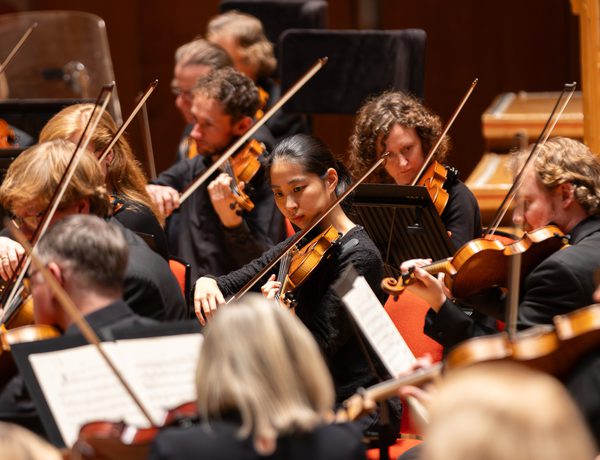
Full programme
- Varèse, Ionisation (6mins)
- Varèse, Amériques (26mins)
- John Adams, Harmonielehre (40mins)
Performers
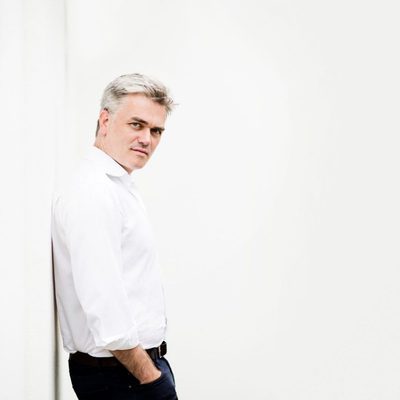
Edward Gardner
Conductor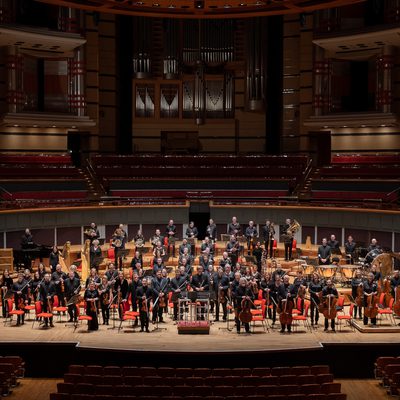
City of Birmingham Symphony Orchestra
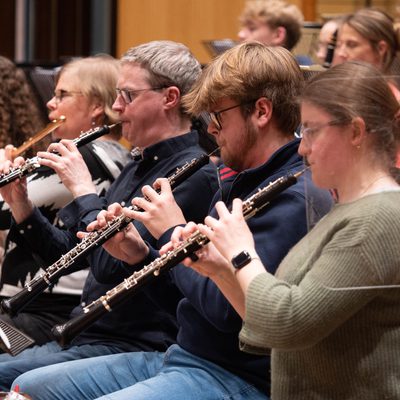
CBSO Orchestral Residency Musicians
Introduction
I'm so thrilled to be performing here tonight! As a longstanding member of the CBSO Youth Orchestra, this feels like a full-circle moment to be performing with the CBSO here at Birmingham's iconic Symphony Hall.
This evening's concert marks the end of a busy week of rehearsals, masterclasses and career guidance. The CBSO's Orchestral Residency gives emerging musicians the chance to gain professional experience, performing large-scale works whilst receiving mentoring from members of the CBSO. As I head into the final year of my Master's degree at the Royal Birmingham Conservatoire, it means a huge amount to share the stage with both my friends and my teachers tonight.
We're joined by a truly special conductor: Edward Gardner, former Principal Guest Conductor of the CBSO and now Principal Conductor of the London Philharmonic Orchestra, has been leading us through the programme this week. It's been an incredible opportunity to work with him and gain insight into these groundbreaking twentieth century works.
Tonight’s programme begins with Edgard Varèse's Ionisation, a piece for percussion alone, inspired by the composer's fascination with physical phenomena. From there, we are then thrown into the chaos and cacophony of Manhattan's West Side, with Varèse's Amériques. The concert finishes with Harmonielehre by John Adams, a bold rejection of Schoenberg's 12-tone system. These works feature a more complex orchestration than a typical symphony, and require many of us to perform on multiple instruments, like myself on flute, alto flute and piccolo. Listen out for sirens, sleigh bells and even lion roars!
Programmes like the Orchestral Residency are vital for helping emerging musicians make the leap from conservatoire into professional life. Having come through the youth orchestra and been inspired by the CBSO's performances over the past five years, it's a privilege to play alongside the musicians who have helped shape my career. Thank you for coming, I hope you enjoy the concert.
Lottie Mahoney
Orchestral Residency participant
Programme Notes
In a programme which celebrates scale, ambition and sheer sonic impact, the CBSO is joined by an exceptional cohort of young musicians as part of the first CBSO Orchestral Residency programme. Following a week-long residency, led by conductor Edward Gardner, the 130-strong ensemble will perform three landmark pieces which have redefined orchestral mass and momentum: Varèse’s Ionisation and Amériques unleash explosive colours and boundary‑pushing energy, while Adams’ Harmonielehre offers sweeping rhythmic drive and luminous, modern‑Romantic power. Together, these works showcase the brilliance of a huge orchestra in full flight, and the exciting new talent shaping its future.
Ionisation / Amériques
Edgard Varèse (1883-1965)
Imagine being a young composer whose creative past has been erased – with no option but to rebuild from the ground up. Edgard Varèse wasn’t supposed to be a composer at all: his parents made him abandon his musical studies to train as an engineer. Defiant, he broke away and acquired a musical education at Paris’s bastion of tradition, the Schola Cantorum. Debussy and Richard Strauss urged him on, and by the time he was invalided out of the French Army in the first months of World War 1 he’d composed symphonic poems and was working on an opera. He moved to the USA in December 1915, settling in Greenwich Village. It was there he learned that almost all of his music had been destroyed in a warehouse fire in Berlin, in 1918.
It was a burned-bridge moment. Instead of looking back, Varèse moved forward. America, in his eyes, was a land “symbolic of discoveries - new worlds on earth, in the sky, or in the minds of men” and in time, he would formulate a new philosophy of music as “organised noise”, imagining sounds as unbounded and mobile physical forms. Varèse dazzled the 1920s avant garde (the novelist Henry Miller called him a “stratospheric colossus of sound”) and went on to explore the possibilities of electronic music. Surviving into the 1960s, he was hailed as prophet by counterculture icons as varied as John Cage, Frank Zappa and the jazz titan Charlie Parker.
For now, though, stranded in his Manhattan apartment on the brink of infinite possibilities, he drank in the sounds around him and began his first composition in the New World: Amériques. Composed between 1918 and 1921 and premiered in 1926 (first to hisses, and then to cheers), this 26 minute work for a huge orchestra isn’t so much a tone poem about New York (though it is certainly that) as a musical conquest of a new continent of sound. That demanded unheard-of resources – at least 125 musicians playing (among other things) ratchets, whips, boat whistles, wind machines and (unmistakably) sirens.
This is very definitely urban music, and equally obviously, 20th century music – forged (in the words of the American writer Thomas May) from the West Side’s “exhilarating aural cacophony of street noises, police cars, firetrucks, river sounds, foghorns, and skyscraper construction”. Varèse himself recalled “all the river sounds - the lonely foghorns, the shrill peremptory whistles - the whole wonderful river symphony which moved me more than anything ever had before." So if the quiet flutes of the opening evoke the impressionist world of France and the expectant opening of Stravinsky’s The Rite of Spring (blurred together as if through the haze of memory), we’re soon in a very different and utterly original soundscape. The concrete becomes boundless; the local becomes universal. America, observed Varèse, stood for “all discoveries, all adventures…the unknown, new worlds on this planet, in outer space, and in human minds.”
But Amériques was still only a step towards true liberation – the music of Varèse’s dreams, in which all sonic possibilities were available to the composer. “Our musical alphabet must be enriched” he told an interviewer. “We also need new instruments very badly”. He soon realised that “new instruments” already existed in the percussion section (they were simply under-exploited), and Ionisation – composed between 1929 and 1931 for 13 percussionists – was in its own way even more of a revolution. "I was not influenced by composers as much as by natural objects and physical phenomena" he explained. Only three of the 30-plus instruments (the piano, glockenspiel and celesta) can even play pitches as they’re usually notated.
Instead, Varèse creates melody where conventional classical music insisted it was impossible – in the colours, timbres and (yes) pitches of the un-tuned instruments. The scientific title was significant: during ionisation, atoms acquire a positive or negative charge. In this extraordinary five-minute sound experiment, supposedly neutral sounds reveal complex and vibrant personalities. Varèse wasn’t the first composer to write for percussion ensemble, but he was the first to write a masterpiece.
Harmonielehre
John Adams (b.1947)
A mighty chord from the full orchestra, then another, and another: driving forward and proclaiming, powerful and proud, the one thing you’re not supposed to have in late 20th century classical music – a key. If the opening of John Adams’s Harmonielehre reminds you of the final moments of Sibelius’s Fifth Symphony, or the raw energy of Beethoven, rest assured: that’s wholly intentional.
And if it doesn’t: well, that’s good too. There’s something else going on here. John Adams has described how one night in San Francisco in 1984, he had “a vivid dream”:
I was crossing the San Francisco Bay Bridge. In that dream I looked out to see a huge oil tanker sitting in the water. As I watched it slowly rose up like a Saturn rocket and blasted out of the bay and into the sky. I could see the rust-coloured metal oxide of its hull as it took off. Shortly after, possibly the very next day, I sat down in my studio to find, almost as if they were waiting for me, the powerful pounding E minor chords that launch the piece.
It’s a seismic moment. For Adams minimalism had started to feel like a cul-de-sac, yet the alternative - the unlistenable “squeaky-gate” music that got you tenure on US campuses – seemed positively toxic. (Arnold Schoenberg was the Dead White European Male presiding over that particular scene. Adams actually had nightmares about him). For eighteen months before he started Harmonielehre, Adams had suffered an “agonising” creative block. Those opening chords are a moment of breakthrough – the moment that different paths converged onto a shining new freeway.
And so here it is: a full-scale symphony, expressed in the bright, rhythmically-driven language of American minimalism. Impossible? Just listen. The name comes from Schoenberg’s 1910 textbook on western harmony. Adams confronts and honours that tradition, but he’s also doing something wholly new. After all, his first child had just been born (we’ll hear from her shortly). He wrote Harmonielehre, he says, “lovingly, and entirely without irony”.
The first movement has no title. That opening blast provides its own impetus and symphonic logic – “high energy at the beginning and end” says the composer, “with a long, roaming Sehnsucht [yearning] section in between”. The Anfortas Wound explores that longing in the tormented language of Wagner and his disciples (but notice that Adams doesn’t use Wagner’s exact spelling for Amfortas, the king in Parsifal whose mission is to bring renewal, but who instead suffers a wound that can never heal). This is the symphony’s dark heart: the dissonant scream at its climax is the same one that pierces slow movements by Schubert, Bruckner and Mahler.
Suddenly the shutters fly open and Californian sunlight streams in. “Quackie” was the Adamses’ pet name for their new-born daughter Emily. In Meister Eckhardt and Quackie, Adams dreams that she “rides perched on the shoulder of the Medieval mystic, Meister Eckhardt, as they hover among the heavenly bodies like figures painted on the high ceilings of old cathedrals.” The music starts as a luminous cradle-song; then accelerates. The final pages of Harmonielehre are a resolution, an affirmation, and (give or take a few unanswered questions) a homecoming.
© Richard Bratby
CBSO Orchestral Residency
The CBSO Orchestral Residency offers exceptional young musicians aged 21 to 25 the opportunity to rehearse and perform alongside one of Europe’s leading symphony orchestras, directed by some of the most inspiring conductors of our time.
The programme consists of an intensive residential week of activity in July every year, culminating in a concert at Birmingham’s Symphony Hall. It combines incredible music-making with networking, mentoring, and professional development – giving musicians real insight into the life of a modern orchestral player.
Orchestral Residency 2027
The residency returns in 2027 with another extraordinary opportunity for young musicians to perform alongside the CBSO. Participants will join the orchestra for a spectacular concert featuring Anna Clyne's vibrant PALETTE and Richard Strauss' monumental Alpine Symphony – conducted by our Music Director, Kazuki Yamada.
Applications for the 2027 residency will open later this year – keep an eye on the CBSO website for full details and how to apply.