Kazuki conducts Rhapsody in Blue
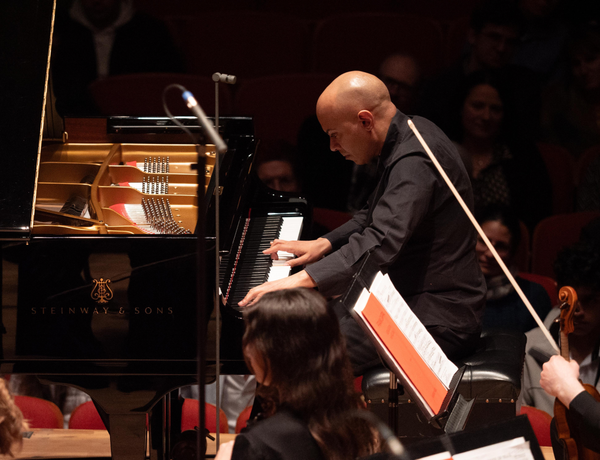
Full programme
- Carlos Simon, Hellfighters’ Blues (5mins)
- Missy Mazzoli, Sinfonia for Orbiting Spheres (9mins)
- Gershwin, Rhapsody in Blue (17mins)
- Ives, Three Places in New England (22mins)
- Gershwin, American in Paris (20mins)
Performers
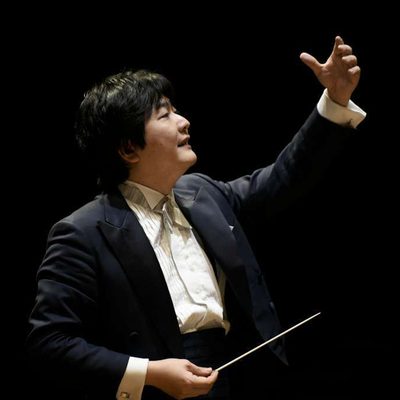
Kazuki Yamada
Conductor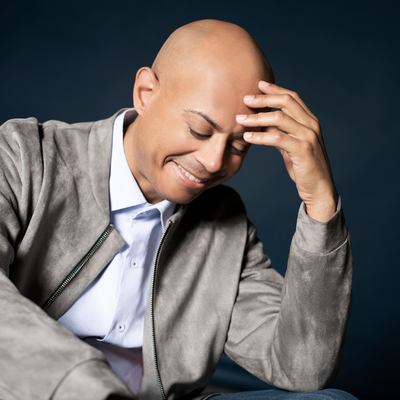
Stewart Goodyear
Piano
Introduction
Today marks my second performance with the City of Birmingham Symphony Orchestra – my last performance with this orchestra was a real highlight for me so I cannot wait to work with them again.
I first worked with Kazuki Yamada nearly three years ago playing Tchaikovsky’s Piano Concerto No.1 with the National Symphony Orchestra so I’m also thrilled to be connecting with him again and to bring Gershwin’s Rhapsody in Blue to life!
I wanted to be a pianist from the young age of three – I was fascinated by the many different sound worlds of different composers from a very young age. Gershwin really struck me as a composer because I never heard a New York soundtrack as vividly as I did in his music. He prompted my desire to visit New York and experience the attitudes, sounds and busyness of the urban setting that is so often included in his music.
Rhapsody in Blue was one of the many pieces that influenced this longing when I was younger. The piece begins almost in suspense, with no idea how the piece may carry on: from the wailing of the clarinet and the ‘wah-wah’ of the muted trumpets, I remember being hooked right there and then before the piano had even entered.
I first performed the piece when I was twelve and I think one thing that makes it such a joy to perform is that every time I play this piece, it’s an entirely different experience. My interpretation is really dictated by that opening melody from the clarinet – it helps inspire what musical journey I choose to take in the next sixteen minutes.
The orchestration and piano writing is simply sublime – one of my favourite moments in the piece is the romantic theme that is developed by the orchestra. It’s super lush, blues-y, intimate. It is introduced by this big virtuosic, octave flourish in the piano where I almost go absolutely berserk in what is possibly one of the loudest parts of the piece. It signals caution in the wind and allows me to have my rock 'n' roll moment in the piece. We go from this grand, stadium-like passage, to an immediate intimate and cosy setting – the drastic change is quite the challenge!
To those listening to this piece for the first time, I feel honoured to be introducing it to you, and to those for whom it’s a familiar favourite, I hope my interpretation allows you to hear it in a new light.
Stewart Goodyear
Piano
Programme Notes
This is an exhilarating musical road-trip through America, a dash across the pond and a flight into outer space. Go back in time with the Harlem Hellfighters, the band of Black Americans who brought jazz to Europe, then sashay through the city with Gershwin’s oh-so-smooth Rhapsody. Go further into the past to hear Ives’s sounds of New England in the Civil War. Zip across the Atlantic to stroll the Parisian streets. Finally, leave the earth behind and experience Mazzoli’s Orbiting Spheres in all their mysterious glory. The phenomenal pianist Stewart Goodyear takes the piano seat and Kazuki Yamada leads the CBSO in this superb and thrilling programme.
Hellfighters’ Blues
Carlos Simon (b. 1986)
Carlos Simon’s Hellfighters’ Blues is a tribute to a Black American Infantry Regiment, a bandleader and soldier, and to the spread of jazz from America to Europe. The band of the 369th Infantry Regiment (which was also known as the Harlem Hellfighters) was led by second lieutenant James Reese Europe during World War I. Accompanying the Regiment to Europe, tasked with boosting morale, they introduced jazz for the first time to British and French audiences (the 369th in fact fought with France, as the American forces would not field African Americans in battle). For bandleader Europe, the music the Hellfighters performed, and that which Europe himself composed, was personal and political, as Reese put it: ‘it's been created by the sufferings and miseries of our race.’
Hellfighters’ Blues takes its cue from, in particular, a piece by WC Handy called Memphis Blues which the Hellfighters would often play in France. Strings and percussion dance rhythmically, while Simon punctuates the piece throughout with brass blues riffs and jazz figures – those thrilling new sounds that Europe brought to Europe.
Sinfonia for Orbiting Spheres
Missy Mazzoli (b. 1980)
Mazzoli’s Sinfonia (for Orbiting Spheres) is a meeting of old (ancient, indeed) and new. Its music conjures up the drone of a medieval hurdy-gurdy and evokes the timeless revolution of the planets; all this is filtered through a vividly contemporary orchestral sound, and a subtle infusion of electronics . As Mazzoli puts it, this ‘is music in the shape of a solar system, a collection of rococo loops that twist around each other within a larger orbit.’ After a slow, misty start the ‘loops’ become more agitated – as if illuminated by a passing planet – then, before receding into the distance, announce their immeasurable grandeur with a brass chorale of great sternness.
Rhapsody in Blue
George Gershwin (1898-1937)
The premiere of Gershwin’s Rhapsody in Blue was a major moment in American concert history and – just over 100 years later – is much discussed even today. The Rhapsody was first heard as part of an incredibly long concert entitled ‘An Experiment in Modern Music’ – the programme of which was jazz-focussed - at the Aeolian Hall, New York on 12 February1924. Works of other American composers featured on the bill, such as Victor Herbert and ‘novelty pianist’ Zez Confrey, and Gershwin’s new work was the penultimate piece – by which time some of the audience had left, and others were bad-tempered with fatigue. It was, however, rapturously received in the hall; while the critics were less impressed, tending toward condescension (one critic wrote that Gershwin had ‘made an honest woman out of jazz’).
From whatever perspective, Rhapsody in Blue has remained a stalwart of the concert hall, as well as having a busy social life at the movies. Throughout the twentieth century and beyond it has become shorthand in cinema soundtracks for a glittering kind of East coast life: the opening clarinet swoop blending with the stylish monochrome opening of Manhattan (1977); the dance-rhythms fusing with the life of the main character in The Great Gatsby (2013); or the sound world evoking metropolitan romance for the chaotic lead of Trainwreck (2015). Its ‘Rhapsodic’ nature defies formal analysis, and instead the piece is a vivacious collection of themes and styles, creating an overall ‘montage’ effect, linked together by improvisatory-like bursts from the solo piano. Its frenetic high spirits calm briefly in the centre of the piece, giving way to a purely romantic melody. Yet it does not take long for the insistent rhythmic drive – what Gershwin called the ‘rattle-ty bang’ - to start up again. As a more friendly critic, Olin Downes, wrote after the premiere ‘the audience was stirred and many a hardened concertgoer excited with the sensation of a new talent finding its voice.’ Audiences are surely still stirred more than a century later.
Three Places in New England
Charles Ives (1874-1954)
The music of Charles Ives has, as the New Grove Dictionary puts it, ‘an unparalleled ability to evoke the sounds and feelings of American life.’ Throughout his unusual career – he worked for years as an insurance agent alongside composing – Ives absorbed the hymn tunes, band marches and folk music of the world around him. At the same time he developed a highly individual musical language, fusing more traditional American tunes with an eclectic, modern approach. His ‘Three Places’ are American to their core: rooted in New England and concerned with significant events in US history, principally battles of the Civil War. Each movement is a network of recollections, many of them concerning active experiences: marching, fighting, being killed (the first movement is effectively a slow march into battle). The entire work somehow anticipates film music in its epic scope and its ability to conjure up a ‘montage’ effect of scenes and landscapes.
In the first two movements, fragments of tunes weave in and out of the orchestral texture – from spirituals to military songs, and from marching tunes to bursts of Wagner (the ‘Ride of the Valkyries’ makes a cameo appearance in the second movement). These melodies frequently collide with each other or segue abruptly into another tune. This happens to some extent in the poignant ‘St Gaudens’ but is especially true of ‘Putnam’s Camp’ in which sounds of the band at a picnic mingle in a young boy’s imagination with battle cries and trumpet calls. In the movement’s final stages the US national anthem makes a bid to be heard out of the melée of swirling orchestral texture. The third movement takes a break from a military narrative and instead evokes the flow of the Housatonic River, by turns serene and turbulent.
An American in Paris
George Gershwin (1898-1937)
The city of Paris has long been a subject of fantasy and romance across all art-forms – perhaps most extravagantly in Hollywood films, where the figure of the ‘American’ gazing in enchantment at the Eiffel Tower, the Seine or simply a cobbled street often generates movie magic (see French Kiss, Before Sunset, and any number of Audrey Hepburn films for perfect examples). In Midnight in Paris, the wistful male lead finds himself transported back from 2011 to the 1920s to hang out with Ernest Hemingway and Gertrude Stein. This is the era in which George Gershwin – another American in Paris – found himself walking the streets, and inspired to compose his gloriously evocative orchestral piece. As well as depicting the city itself, Gershwin’s own starry-eyed enthusiasm is written into the chipper rhythms of the opening section as listeners are led through Paris accompanied by the sound of car-horns (he brought back to the US some authentic Parisian taxi horns to use in the early performances). The more jazz-imbued sections are suggestive of the American’s homesickness, with a slinky melody and a passage resembling the Charleston. The ‘strolling’ melody returns, as the American begins to sink into Parisian life.
Gershwin had begun the piece during his first trip to Paris in 1926, and completed it following his second visit in 1928. In between, he met the French composer Maurice Ravel, who had visited New York and was in turn intoxicated by that city (and wrote a jazz-inspired Piano Concerto not long after). A Hollywood film was later inspired by Gershwin’s work: Gene Kelly’s An American in Paris in 1951 created a whole narrative out of the score, and choreographed numerous sequences to this and other pieces by Gershwin. In 1963’s Charade, set in Paris (with Americans), Audrey Hepburn even refers to Gene Kelly dancing along the Seine in the earlier movie. Gershwin’s colourful, continent-hopping work is a gift that keeps on giving.
© Lucy Walker
Featured image © Hannah Fathers