Kazuki conducts Strauss
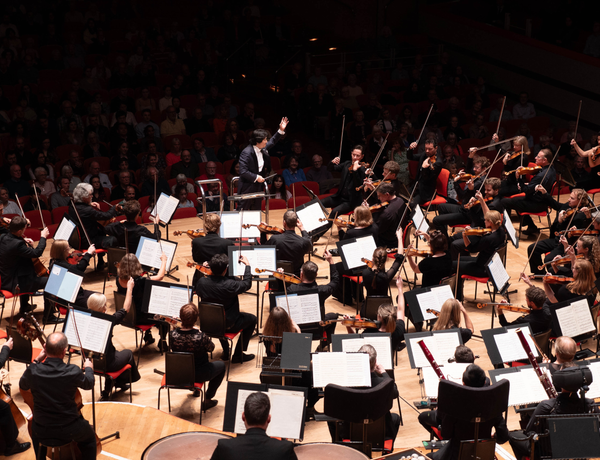
Full programme
- Strauss, Death and Transfiguration (24mins)
- Strauss, Oboe Concerto (26mins)
- Strauss, Also sprach Zarathustra (32mins)
Performers
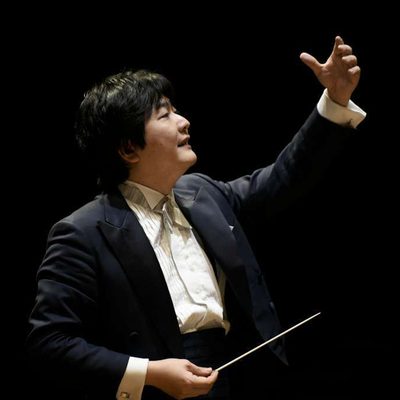
Kazuki Yamada
Conductor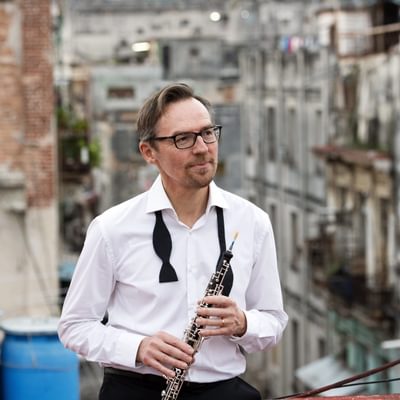
Jonathan Kelly
Oboe
Introduction
Tonight’s concert means a lot to me. On this very stage back in 1993 I played Richard Strauss’ Oboe Concerto when I auditioned for the position of principal oboe of the CBSO.
A decade later I performed it with the CBSO just a week before my audition for the Berlin Philharmonic. I’m delighted to be back many years later to perform it once again with old friends (and quite a few new faces too).
Strauss wrote this concerto when he was in his eighties, with the smoke, dust and ashes of the second world war still settling around him. His response to the horror and destruction of war was a composition of lyrical simplicity and autumnal beauty.
In this concerto Strauss honours the classical proportions and intimacy of the composer he idolised, Mozart. I particularly enjoy the highly vocal nature of Strauss’ writing; it’s such fun to have the opportunity to ‘sing’ my very own extended operatic aria on the oboe!
Contrast the modest scale and restraint of the concerto with the other works on tonight’s programme. In his early tone poem Tod und Verklärung, the young and ambitious Strauss employs a large orchestra to probe deeply into metaphysical questions of mortality and spiritual enlightenment.
In Also sprach Zarathustra, Strauss, at the height of his powers, treats us to a tour de force of orchestral effects and virtuosity whilst grappling with the existential questions about life, the universe and everything posed by Nietzsche in his philosophical novel. The final chords of this masterpiece seem to leave those questions hanging in the air.
Fifty years later, writing his oboe concerto, having experienced political upheaval, societal collapse, two world wars and untold destruction, had Strauss found the answer to these questions? Listen and decide for yourselves!
Jonathan Kelly
Oboe
Programmes Notes
Two epic tone poems from early in Strauss' career find the composer questioning the meaning of life and death. Epic fanfares, waltzes and soaring themes seem to provide the answers. Decades later, his sweet and lyrical Oboe Concerto rose out of the rubble of war-devastated Germany, effectively commissioned by a young American soldier (who happened to be an oboist!). Principal Oboist of the Berlin Philharmonic and former CBSO Principal Oboe Jonathan Kelly takes on the solo duties, with the CBSO conducted by Kazuki Yamada.
Richard Strauss (1864-1949)
Death and Transfiguration
The young Richard Strauss was hardly short of ambition. As Bryan Gilliam puts it in a biographical sketch of the composer, by the age of 22 he was ‘brash and talented’, well on his way to achieving a successful career as a conductor, but ruffling feathers as he went. Applying the same character traits to his compositions resulted in an extraordinary outburst of experimentation and originality in the mid-late 1880s, largely centred around his cultivation of the tone poem. Under the influence of both Liszt – who had written ‘symphonic poems’ – and Strauss’s friend Alexander Ritter, Strauss increasingly believed that ‘abstract music’, such as sonata form, was nothing but ‘a hollow shell’.
Death and Transfiguration (or Tod und Verklärung) was composed in 1888, and depicts the final moments of a dying artist. Rather than descending into pathos and gloom, it journeys from initial anxiety and agitation to fond memories, and ultimately to a final, blissful ‘transfiguration’. Strauss had asked Ritter to provide some words describing the internal journey of a dying soul; when the piece was performed, Ritter’s poem was adapted as a four-part description of the ‘action’. The first part depicts a man ‘lying in a shabby room’, listening to the irregular beat of either a clock or his own heart; periodic rising fourths in the woodwind emerge from the misty texture, foreshadowing the ‘transfiguration’ theme. Solo violin, flute and oboe play out various lyrical themes, suggesting happy memories of the man’s childhood. Yet before these can be developed further, there is a passage of great turbulence – as Ritter’s description has it, a ‘struggle between life and death’. The music peaks dramatically with the first presentation of the full ‘transfiguration’ theme, rising heroically through the texture.
The man, however, is not quite ready to let go, and further memories keep him tied to earth, depicted by variations on the earlier woodwind themes, along with terrifying ‘hammer blows’ and an ominous thwack on the tam-tam. In the final section – which moved even Strauss’s deeply conservative father Franz – the man’s soul is transfigured into an ecstatic release.
Oboe Concerto
Strauss’s Oboe Concerto has one of the most unusual back stories of his works. It was written during Strauss’s remarkable ‘late’ period from 1942-45, when the composer was entering his ninth decade and writing some of his most graceful and deeply-felt works. When the war ended in 1945, he was living in his villa at Garmisch in Bavaria, where his son and Jewish daughter-in-law had been under house arrest for several years. (Strauss’s behaviour during World War II can be perceived as an uncomfortable mix of self-interest, an apparently wilful obliviousness to the politics of Nazism, but also some genuine efforts on behalf of his family, particularly his Jewish in-laws.) He had in the previous few months poured his complex feelings into a work of ‘memorial’, the profoundly tragic Metamorphosen for string orchestra. After its completion in April 1945, the American army had arrived on the outskirts of Garmisch with, according to Jeremy Eichler, the intention of commandeering Strauss’s villa. The composer greeted the soldiers cheerily with offers of tea and waltzes from Rosenkavalier on the piano, and they left his house alone. One of their number, a corporal by the name of John de Lancie, had been principal oboist with the Pittsburgh Orchestra in civilian life and asked Strauss whether he had ever considered an oboe concerto. The composer was not interested at first, but within a few weeks a concerto began to form in his mind and he had completed it by October 1945. De Lancie was somewhat astonished to read about it in a newspaper the following year.
Compared with Metamorphosen the Oboe Concerto is an uncomplicated and absolutely sunny work, strong on charm and unabashed in its avoidance of modern harmonic developments. It could, almost, have been composed several decades earlier, though the opening shuddering figure in the strings, murmuring throughout the movement, gives it a contemporary edge. The soloist is challenged from the outset: after only a few beats, it launches into a lung-busting melody, some 51 bars in length with barely a pause for breath. This passage sets the tone for the abundance of lyrical invention in the movement as a whole, shared between orchestra (small by Strauss’s usual standards) and soloist, including a reprise of the opening salvo towards the end. The ‘shuddering’ both concludes this movement, and heralds the start of the next, which treats us to another long-breathed solo from the oboe, this time aria-like in character, as if lifted from a bel canto opera. The brief cadenza, over plucked strings, is similarly operatic and structured like an anticipatory passage of recitative; indeed, it plunges straight into the absolute romp of a finale. Dance-like and playful, this movement is an expression of sheer high spirits: an alternative universe, perhaps, to the rubble and horror of 1940s Europe.
Also sprach Zarathustra
Strauss' sixth tone poem has possibly the most famous opening of any musical work, apart from that of Beethoven’s Fifth Symphony. As a result, both pieces are not only regulars on the concert platform but have made the often difficult journey across cultural boundaries. There is a disco version of the Beethoven symphony (‘A Fifth of Beethoven’), while Also sprach Zarathustra has been given the jazz-funk treatment by Brazilian artist Eumir Deodato, as well as by Stan Kenton in ‘Zarathustrevisited’). The opening movement (‘Sunrise)’ of Strauss’s tone poem has, of course, appeared in the soundtrack for several films, such as the opening of Stanley Kubrick’s 2001: A Space Odyssey, itself parodied in The Simpsons, and the recent Barbie movie, both retaining the Strauss music.
The eclectic and sometimes hyperbolic range of purposes to which ‘Sunrise’ has been put is appropriate, in some ways, to Strauss’s musical treatment of the piece as a whole. The musical styles range from sweet string chorales (second section) to a ‘scientific’ fugue (sixth section, following a sepulchral trip to the ‘grave’) to a delirious waltz in the penultimate section. The orchestra itself embodies glorious excess, including organ (making a spectacular first appearance towards the end of ‘Sunrise’) and a large brass section. Indeed, Strauss’s approach needed to be all-embracing and huge in scale to match, as far as possible, the ambition of the source material: Nietzche’s 80-part work of philosophical fiction of the same name. It represents the journey of the hermit-philosopher Zarathustra as he travels through the world, discoursing on many subjects including the death of God, the ‘Übermensch’ and the natural world. The opening C-G-C (outlining, for any physicists in the audience, the first three notes of the harmonic series) symbolises nature; while the key of B major represents the progressive and enquiring spirit of humanity. These two keys play off each other throughout, right until the concluding bars: a high B major chord in the wind, counterpointed by almost inaudible low Cs in the double basses.
In between are seven movements, mostly with subtitles taken from Nietzsche’s work, and traversing a vast range of human and spiritual experiences. Perhaps the most extraordinary sequence is that of the final three sections. In the seventh, entitled ‘The Convalescent’, the C-G-C motif blasts out against a backdrop of frantic harmonic and orchestral activity before blazing into the foreground followed by a sudden silence; B major then intervenes, darkly and in a low register at first, before gradually working through the registers to a thrillingly strange, high-pitched texture of whistling woodwind and twinkling percussion. The C-G-C motif is heard once more, before segueing into a C major waltz. Nature now appears to have the upper hand, but after tolling bells, the final section begins to slide back into man’s realm of B. Zarathustra’s musical quest concludes, though, with that ambiguous dialogue between the two key centres in the final bars.
© Lucy Walker
Featured image © Jenny Bestwick