Philip Glass' Double Timpani Concerto
Full programme
- Philip Glass, Double Timpani Concerto (27mins)
- Carlos Simon, Four Black American Dances (14mins)
- Rachmaninoff, Symphonic Dances (40mins)
Performers
Alpesh Chauhan
Conductor
Matthew Hardy
Timpani
Toby Kearney
Timpani
Introduction
Dance and music are inextricably linked - dance and percussion even more so. This evening’s concert is wall to wall rhythm, dance and energy featuring music from three composers at their very best, putting timpani and percussion front and centre.
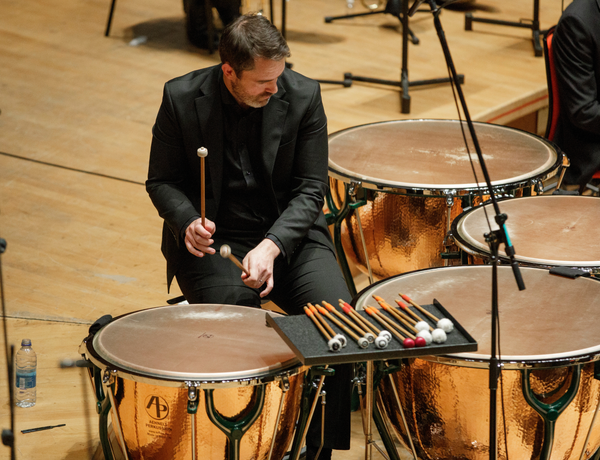
The front of the stage is a very unfamiliar place for timpanists; indeed, timpani are probably the last instrument you’d expect to hear in a concerto. But the genius of Phillip Glass’ Fantasy is the way he weaves the timpani in and out of the orchestral texture, sometimes driving the orchestra with endless rhythm, sometimes taking the lead with sweeping melodies - a rare treat for us! This concerto certainly has that classic minimalistic Glass feel with a cinematic sound, driving rhythmic repetition, high energy and lush orchestral textures.
The eagle-eyed amongst you might notice how busy our feet are; one of the biggest challenges is changing pitch with the pedals hundreds of times, often many times in just one bar. The freeform cadenza is also a chance for us to show some of our favourite extended techniques on timpani, see if you can work out what we’re doing! It’s been so much fun for us to learn this piece together and bring it to life with Alpesh and our friends.
Every note written by Carlos Simon oozes style and his Dances are no exception. Each section of the orchestra has its moment to shine and the piece is so full of rhythm and character - we won’t be surprised if you end up dancing in the aisles.
Rachmaninoff’s Symphonic Dances has to be one of our absolute favourite pieces to play - between us we think we’ve played over 50 times - so we’re very happy to be back in our natural habitat on the back riser for this one.
So, whether you're dancing or listening, you’re sure to be tapping your feet - by the end of the programme, we’ll certainly be on our last legs!
Matthew Hardy and Toby Kearney
Timpani
Programme notes
Shall we dance? This concert suggests we do and invites us to learn about the history of dance itself under the baton of Alpesh Chauhan. Simon’s Four Black American Dances are depictions of rituals and traditions from Black communities, born out of and in response to their changing social contexts. Rachmaninoff’s Dances – his final work – whirl and weave through a series of contrasting moods, ending in a glorious party. And Glass’ Concerto – a rare chance to see the timpani up front and central – grooves and swings with an irresistible beat. CBSO’s Matthew Hardy and Toby Kearney take the solo spots.
Double Timpani Concerto
Philip Glass (b. 1937)
In an article for the Guardian in 2012, broadcaster Tom Service asked ‘can any of us imagine a musical world without Philip Glass?’. It is a comment which speaks to the composer’s innovative, at times radical method of musical construction, which has left an indelible mark on both concert and film music. In the 1960s Glass worked with an eclectic range of musicians, with lessons in Paris from the grande dame of composition teaching, Nadia Boulanger, and a formative apprenticeship to Ravi Shankar on the film score for Chappaqua (1966). Returning to America, Glass created his influential – and mesmeric - Music in 12 Parts, worked on further film scores, and – in a surprising twist – renovated apartments with film director Kathryn Bigelow (Glass did the plumbing, Bigelow sorted the plasterboard). It’s fair to say that, with Glass, normal rules do not apply.
The same could be said for his Double Timpani Concerto, written in 2000 for the timpanist Jonathan Haas. While the timpani has a fairly limited melodic range (often limited to two or three notes), it has an undeniable presence in any symphony orchestra, frequently responsible for dramatic builds, portents of doom, or simply hell-for-leather domination (in Nielsen’s Symphony No.4, for example, a pair of duelling timpanists are asked to play ‘with a certain menace’; they effectively silence the rest of the orchestra). Here, any potential ‘menace’ is tempered by a kind of rhythmic cooperation between the two soloists, while the rest of the ensemble provides a melodic sheen over their complex, interlocking beats.
The concerto opens with a punchy, irregular riff, somewhat similar to Lalo Schifrin’s famous Mission: Impossible theme. This motif dominates the opening moments, then gradually evolves into a more regular beat, yet one which is consistently disrupted by interplay across the various orchestral sections. A more straightforwardly lyrical passage, almost celebratory in tone, concludes the movement. The second movement opens in a mood of solemnity, with low brass and strings growling under the somewhat militaristic timpani rolls. The movement as a whole is in a state of suspension, as if building to a very slow peak. Slow-moving melodic figures are coupled with Glass’s characteristic ‘rocking’ figures, while the soloists provide the momentum. The movement concludes more or less where it began, with the addition of soft, chiming bells. The soloists take the spotlight for the cadenza, drawing on rhythms and gestures from earlier in the work. Its propulsive energy expands into the dance-like finale, which concludes in a joyfully uninhibited romp to the finish line.
Four Black American Dances
Carlos Simon (b. 1986)
In a television interview in 2023, Simon remarked that his musical career ‘really started in church’ which, he added, was ‘always part of his musical DNA’. His father was a pastor in Atlanta where Simon grew up, and the music he was mainly exposed to as a child was gospel, and what he calls ‘the exuberant outward expressions of worship’ in the Pentecostal church. This is embodied brilliantly in the ‘Holy Dance’ movement of Four Black American Dances. The presence of dance, as well as religious ecstasy, is a further tribute to Simon’s Black American heritage, specifically those dances which, as Simon puts it, ‘originated from the social climate of American slavery, Reconstruction and Jim Crow.’
The exuberant ‘Ring Shout’ channels the freedom and transcendence of the ‘ring shout’ ritual, which was performed by enslaved Africans and involved stomping and clapping while moving in a circle. Instruments whoop and ‘shout’, sometimes deliberately out of sync, while players are invited to join in the clapping. The presence of a ‘Waltz’ in this group of dances speaks to both the long era of segregation, during which Black Americans were not permitted at formal dances, and to the gradual emergence of Black societies where the waltz was, as Simon writes ‘the dance of choice’. Simon’s ‘Waltz’ is elegant and dreamy, channelling the blues more than Johann Strauss, yet has a tentative quality to its 3-in-a-bar rhythm, and ends in a mood of fragility. ‘Tap’ is both a dance and, it seems, an instruction to the snare drum player, who taps the rim of the instrument for extra percussive appeal in this infectiously rhythmic movement. In ‘Holy Dance’, the orchestra alternates between coordinated bursts of joy and freewheeling episodes, imitating the sound of ‘speaking in tongues’ heard in Pentecostal services. The atmosphere is one of exhilarated liberation, building eventually to a huge ‘Amen’, complete with ringing bells, for the whole orchestra.
Symphonic Dances
Sergei Rachmaninoff (1873-1943)
The Symphonic Dances (1940) was the last piece Rachmaninoff completed yet its high spirits bely the composer’s ill-health and exhaustion (he died only three years later). Although Rachmaninoff was known for his magically long-breathed melodies – and there are several here – his Dances are also rich in imaginative orchestration including, for the first time in one of his scores, a saxophone. (Rachmaninoff consulted Broadway composer Robert Russell Bennett about which register of saxophone to use; after listening with some amusement to the composer singing parts of the score down the telephone, Bennett advised the alto.)
The opening rise-and-fall theme dominates much of the first dance, which is initially vigorous and march-like with some punchy interjections from the piano. In a complete change of mood and texture, the clarinet and oboe introduce the beautiful alto saxophone solo, based on a serene version of the opening motif. Piano and strings later take over, bringing a touch of Hollywood ‘swoon’ to the sound world. A sepulchral bass clarinet and contrabassoon herald a return of the opening vigour. In the final moments of this movement Rachmaninoff quotes from his own ill-fated First Symphony, the disastrous premiere of which had caused a serious attack of composer’s block. Here, he converts the Symphony’s grave, minor key theme into the major mode, bells twinkling festively in the background – possibly something of a therapeutic moment for the composer.
Rachmaninoff’s cousin Sophia recalled that the Dances had originally been subtitled ‘Noon, Twilight and Midnight’. If the liveliness of the first movement belongs to the day, the sinister opening of the second dance, associated originally with Twilight, seems apt indeed. From muted brass, the music shifts into a curdled waltz, led by an exploratory solo violin. The rhythm initially suggests hesitancy, or flat footedness, but it builds to a kind of diabolical intensity, the harmonies periodically sliding into wooziness.
The characterful final dance travels through a rapidly shifting series of moods, as if comprising a medley of separate dances. Included in the mix are a number of personal call-backs, notably the ‘Dies Irae’ (day of wrath) plainchant theme, which Rachmaninoff had used in several earlier works (such as his ‘Paganini’ Variations). As the First Symphony’s theme was leavened by bells, Rachmaninoff counters the solemnity of the Dies Irae with an ‘Alleluia,’ quoting from yet another work: his 1915 choral Vespers. The dance’s ‘Midnight’ quality can be heard in the almost stereotypical whirls of harp and strings around the five-minute mark, followed by growls from the low wind and strings. A substantial, lushly scored passage for strings follows, interrupted by a breezy change of mood with trumpets and wind, with brief hints of the ‘dies irae’. The latter theme attempts to asserts itself in the final minutes but is ultimately taken over by the Vespers’ ‘Alleluia’ theme, which generates the glorious momentum of the final bars - and a celebratory final word from their composer.
© Lucy Walker
Featured image © Andrew Fox