Reformation Symphony
Full programme
- Mendelssohn (arr. Widmann), Sonata for Clarinet and Piano: Andante (7mins)
- Jörg Widmann, Paraphrase of Mendelssohn’s Wedding March (5mins)
- Jörg Widmann, Danse Macabre (19mins)
- Mendelssohn, Hebrides Overture (10mins)
- Mendelssohn, Symphony No.5 (30mins)
Performers
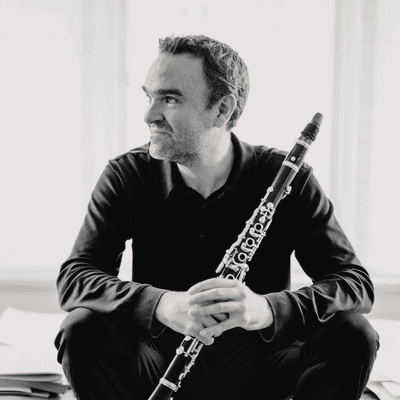
Jörg Widmann
Play/Direct
Introduction
I have loved this orchestra since the first time I played with them. I can’t wait for the pure pleasure of working with such wonderful musicians and human beings. This concert explores some of Mendelssohn’s greatest pieces and as a big fan of his music, I find it is my mission to continue championing his works.
The Hebrides Overture is played a lot and rightfully so – it is the perfect piece of music. Mendelssohn creates so many different moods and musical atmospheres from just one singular thematical idea. I recently visited Mendelssohn’s house in Leipzig and the walls feature many quotes from his contemporaries. Among them Johannes Brahms said: “I would gladly give all I have written, to have composed something like the Hebrides Overture”. Brahms was often known for being so critical of his colleagues but this shows a real love declaration. I too would be so happy and lucky to have written such a piece.
I started playing the clarinet at the age of 7, learning under an Argentinian teacher who introduced me to some amazing arrangements, including Mendelssohn’s Clarinet Sonata. I completely fell in love with the melody and I could not understand why this piece isn’t played by clarinettists more. It prompted me to arrange this piece with added strings. There were certain difficulties, like imitating the sustained pedal in the piano part; I met this challenge by sustaining notes with arco in different string parts. I have not touched the clarinet’s melody but I have added new harmonies and melodies. In a programme of Mendelssohn, I think this piece just cannot be missed out, especially as it is such an important part of my early biography.
My arrangement of Mendelssohn’s Wedding March was commissioned by the architect Daniel Libeskind as a surprise wedding present for his daughter. My sister played it on the violin at the ceremony as a surprise and I think it is the most endearing gift from a father. I had to condense the music to ten fingers on one violin, which was very stereotypical of the paraphrasing style of the 19th century, almost an opposite arranging approach to the Clarinet Sonata!
Mendelssohn’s Symphony No.5 is better known by its title ‘Reformation Symphony’. Written in influence of a visit to my home city, Munich, Felix wrote to his sister how he witnessed a procession of the Catholic Church whilst extraordinarily, 20 metres away, a Bavarian Brass band played. If you listen clearly, you may be able to hear Bavarian yodelling in the woodwinds during the second movement. The chorale deliberates the term ‘devil’ and it was this that gave me the daring idea to combine my Danse macabre in this programme.
We know a multitude of dances from around the world – but there is one dance we do not know: the dance of the dead. My Danse macabre is set at the start of midnight, until we hear the chime of 12 bells in the harp and piano followed by silence, signifying the start of the dance.
Jörg Widmann
Play/Direct
Programme notes
Clarinettist, composer and conductor Jörg Widmann considers Mendelssohn to be one of the greatest composers who ever lived. He loves his quicksilver changes of mood, his instrumental colour, and his ‘fascination with speed’. All this and more can be heard in the magnificent ‘Reformation’ Symphony (No.5) while Widmann filters the Clarinet Sonata and Wedding March through a very quirky, very modern lens. In the middle of it all is Widmann’s own Danse Macabre: hang on to your seat as the orchestra cackles with demonic glee.
Sonata for Clarinet and Piano: Andante
Felix Mendelssohn (1809-1847)
(arr. Widmann)
Jörg Widmann fell ‘madly in love’ with Mendelssohn’s Sonata for Clarinet when learning it for the first time aged only 10 (Mendelssohn himself was only 15 when he composed it). Widmann’s arrangement of the Sonata is part of his ongoing ‘conversation’ with the earlier composer, whose music he frequently conducts and arranges. He remarked in an interview that Mendelssohn might have been ‘astonished’ at his treatment of his sonata, with its ‘multitude of air sounds and unusual playing techniques’, but also hoped that ‘he would have a lot of fun with it’. This seems a reasonable hope, for while Widmann conjures up a very contemporary soundscape, he is clearly deeply respectful of the original. The clarinet maintains its foot in the nineteenth century with its ‘straight’ renditions of Mendelssohn’s lyrical themes. Meanwhile, the surrounding instruments move back and forth across time, sometimes playing fairly conventional accompaniments, at other times bathing the original harmonies in increasingly strange instrumental colours. The appearance of the celesta, with string ‘harmonics’ whistling above the entire ensemble, evokes a chilling atmosphere, as if the 1824 sonata had become the soundtrack to an unsettling fairytale.
Paraphrase of Mendelssohn’s Wedding March
Jörg Widmann (b. 1973)
The Wedding March from Mendelssohn’s incidental music for A Midsummer Night’s Dream may be one of the most recognisable pieces of music in the western world. Its fanfares and triumphant descending melody have accompanied just-married couples back down the aisle since the late 1840s. Widmann takes his own inimitable approach to the famous contours of the original tune. He was commissioned by the architect Daniel Liebeskind and his wife Nina to write a version of the wedding march for the marriage of their daughter in 2016. Widmann scored it for solo violin, specifically for the remarkable talents of his sister Carolin who performed it at the ceremony. The recognisable beats of the march are there – the opening triplet, the descending march theme and rising fanfare – but reframed in an other-worldly and virtuosic context. From hushed, tentative opening (a gentle tapping of those triplets) to final notes marked with the expression sfffffz (in other words, a very loud emphasis), this is a dazzling response to the original: celebratory and unforgettable.
Danse Macabre
Jörg Widmann
In Graham Lack’s article on Widmann in the New Grove Dictionary of Music and Musicians he notes that ‘”Inebriation” and “excess” are watchwords the composer uses often in interview in relation to his work’. These are certainly useful starting points in attempting to describe the glorious mayhem of Danse Macabre. Indeed any attempt at a sober or moderate account of the piece would probably be doomed, but it is helpful to consider Widmann’s own description, which emphasises both the dance aspect of the piece and, despite its ‘macabre’ subtitle, its expression of joy.
It is a last dance, a dance that death dances with us, in ever new turns, pirouettes, masquerades - but it always remains death. …May this dance, even if macabre, bring joy to the orchestra and audience.
After a blistering start, the orchestra appears to reel in shock: the piano dampens its strings; the brass blow soundlessly through their mouthpieces. They gather their forces to play two dangerously catchy dance themes: the first a curdled waltz, the second a Scottish jig. The latter in particular is subject to some raucous and haunting variations across the piece, from trumpet snarls to an eerie version for celesta. It frequently heralds a period of crazed activity, sometimes brought to order by the chiming of bells. In between, we hear ever-queasier versions of the waltz, and passages in which everything seems on the brink of derailing entirely, multiple dance themes and spiky shards of rhythm piling on top of each other. At the end, after a positively terrifying version of the jig, our dance with death comes to an end with a final, explosive chord. What a way to go.
Hebrides Overture
Felix Mendelssohn
The idea of Scotland and Scottishness was very much in vogue among European composers in the nineteenth century, although most of them never actually visited the country. Mendelssohn was one of the few who did, taking a walking holiday there in 1829. While in the Hebrides he wrote a letter to his family, which included the famous opening theme of his Overture, along with a note to his sister Fanny: ‘In order to make you understand how extraordinarily the Hebrides affected me, I send you the following, which came into my head there’. Mendelssohn had taken a trip to the uninhabited island of Staffa, a few miles west of Mull, and the location of Fingal’s Cave (which the Overture is also sometimes called), a place subject to the full might of the Atlantic ocean. Mendelssohn’s theme of only six notes repeats over wavelike figures in the strings, evoking the rough crash of the sea against the rocks.
The second theme rises nobly from the bassoon and low cellos, still amongst the wavelike strings. During the rest of the Overture, the thematic material ebbs and flows across the orchestra, sometimes violently, sometimes serenely, always evocative of the craggy and unpredictable landscape of the western isles.
Symphony No.5
Felix Mendelssohn
Mendelssohn’s ‘Reformation’ Symphony was originally intended to mark the 400th anniversary of the Augsberg Confession, a crucial document of the Protestant Reformation written in 1530, and presented at Augsberg. One of its co-authors was Martin Luther, whose chorale Ein Feste Burg ist unser Gott (A Mighty Fortress is our God) is the basis of the Symphony’s finale. Due partly to ill-health, Mendelssohn did not complete the work in time for the celebrations in 1830, and later lost confidence in it: he withdrew it after its first performance in 1832, and it was not published or performed again until 1868 (which explains the fact that it was in fact composed before symphonies 2, 3, and 4 – but published as ‘no. 5’!). The composer’s attitude – he once suggested the score of no. 5 should be burnt - seems surprising today. For it is a powerful and vibrant symphony, managing to convey both grandeur and a vivacious, sparkling energy.
The opening movement has, initially, a reverential character, punctuated by solemn fanfares. At the close of the first section we hear the ‘Dresden Amen’, a setting of the ‘Amen’ familiar to German churchgoers in the 1800s. It rises softly in the strings, its two iterations sandwiching a further fanfare (listeners familiar with Wagner’s opera Parsifal will recognise it as the theme associated with the Holy Grail). It has a ‘pause for thought’ quality here, especially in its second appearance towards the end of the movement where it has a calming effect on the increasingly chaotic atmosphere. This more turbulent section at times resembles the wilder aspects of Beethoven’s symphonies; despite the Amen’s interventions, this mood lingers until the end of the movement.
The stormy atmosphere gives way to something considerably lighter. A lively, bouncing theme dominates the outers sections of the second movement, while the central passage is elegantly dance-like, with a sense of glee at its own flow of delicious melodies. The third movement is a short, yet passionate ‘song’ with the first violins playing an aria-like melody over lightly-scored accompaniment. A solo flute opens the final movement, gradually joined by other instruments in the first statement of ‘Ein feste burg’. Mendelssohn spends much of the finale weaving colourful variations around this hymn. The tune is dismantled and examined from all angles, turning up in a beguiling variety of instrumental combinations, until the first line of the tune is brought emphatically, and triumphantly to the fore in the final bars.
© Lucy Walker
Featured image © Marco Borggreve