Bach & Beethoven

Full programme
- Beethoven, The Creatures of Prometheus: Overture (7mins)
- Magnus Lindberg, Violin Concerto No.1 (26mins)
- Bach, Oboe Concerto in D minor (13mins)
- Beethoven, Symphony No.4 (36mins)
Performers
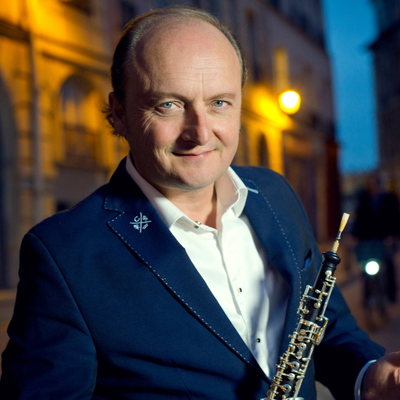
François Leleux
Oboe/Conductor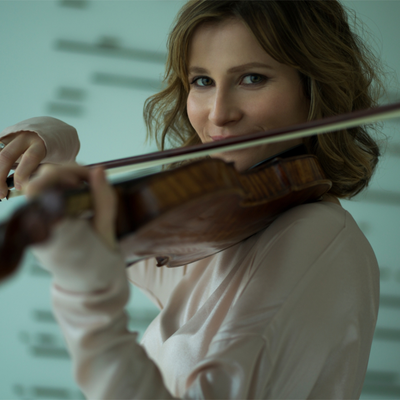
Lisa Batiashvili
Violin
Introduction
I am delighted to be back with the City of Birmingham Symphony Orchestra and to present this special programme together with Lisa Batiashvili.
Sharing the stage with Lisa is always a very rare and precious experience. Alongside our musical lives, we do our very best to be good parents, which makes these moments of performing together even more meaningful.
At the heart of the programme is Magnus Lindberg’s Violin Concerto, a true masterpiece. This concerto is exceptionally demanding and virtuosic, and it carries fascinating echoes of Sibelius’s great Violin Concerto, reimagined through Lindberg’s unique and contemporary voice.
Beethoven guides us through the evening, beginning with the Prometheus Overture, inspired by the myth of Prometheus bringing fire to humanity – a powerful symbol of enlightenment and the birth of human creativity. We then conclude with the radiant and classical Symphony No.4: full of light, clarity, and joy.
I am also very happy to perform the Oboe Concerto in D minor, a remarkable reconstruction, rich in virtuosity and expressive depth, crowned by a stunning slow movement drawn from the cantata ‘Ich stehe mit einem Fuß im Grabe’.
Thank you for joining us and enjoy the concert!
François Leleux
Conductor and Play/Direct
Programme Notes
This concert of captivating orchestral works is a full sensory experience, led by conductor François Leleux. In the first half Beethoven depicts the theft of fire from the Gods, while Lindberg’s crystalline Violin Concerto cools everything down. Soloist Lisa Batiashvili brings out the icy precision of this sparkling work. After the interval is a lyrical, gentle masterpiece by Bach, where Batiashvili is joined by oboist François Leleux for the solo duties. Finally, you will be sent home with a spring in your step after Beethoven’s most good-natured Symphony.
The Creatures of Prometheus: Overture
Ludwig van Beethoven (1770-1827)
Beethoven was not an instinctive man of the theatre. He wrote only one opera, Fidelio, and apart from a youthful attempt at a ballet in his early twenties, The Creatures of Prometheus was his only other theatrical work. He was commissioned to write the music in 1800 by the choreographer Salvatore Viganò, who in turn had been asked to present a ballet to the Archduchess Maria Theresa at the court in Vienna. The scenario was based on the story of Prometheus, the figure from Greek myth who stole fire from the Olympian gods and gave it to humanity. Of the eighteen or so numbers of the original ballet, only the Overture (and occasionally the score’s finale, which included a theme used in the later ‘Eroica’ symphony) is generally performed today.
The story of Prometheus must have strongly appealed to Beethoven at this period of his life. He was greatly in thrall to Napoleon (until he decidedly wasn’t a few years later), who was often described as a ‘Promethean’ figure, bringing enlightenment to the masses; and Beethoven himself became increasingly concerned with bringing ‘freedom and progress’ to the world of art. The opening of his Overture expresses the great nobility of Prometheus’s project, while the exuberance of what follows vividly conjures up the excitement of the mortals who have benefited from Prometheus’s gift of fire and light. While Beethoven’s only professional ballet score did not exactly win the critics over, this Overture has more than a few signs of the orchestral swagger – as well as fire - to come.
Violin Concerto No.1
Magnus Lindberg (b. 1958)
When a piece of music emerges from Finland there is a tendency for those writing about it to conjure up images of icy plains, thick forests and a general atmosphere of forbidding cold. With Lindberg’s Violin Concerto no. 1, in fairness to myself and other writers, these metaphors are in fact somewhat apt. Lindberg’s wonderfully evocative work, premiered in 2006 by Lisa Batiashvili, opens in what a reviewer for the Scotsman called ‘a mesmerising landscape of icicle sharp glissandi’ and with more than a nod to the Violin Concerto of Lindberg’s earlier compatriot Sibelius, composed a century earlier.
The first movement evolves out of icicles into surging slabs of texture – snowdrifts, perhaps, or even avalanches. The orchestra is surprisingly small, built on a ‘classical’ scale (the Concerto was commissioned by the ‘Mostly Mozart’ Festival). Yet it manages to generate a formidable series of tableaux in sound, with moods ranging from anxious to menacing to something bordering on warmth, notably when the horns emerge with their triumphant chorales. The texture never covers the soloist, even when the violin engages in combat with the orchestra; at other times, the soloist coasts serenely with the ensemble, especially when exploring its richer, sonorous lower register.
The first movement concludes with some sepulchral activity for the bassoons and a final flourish for the violin, before segueing straight into the following movement. Opening with an assertive theme for woodwind alternating with some stark chords, both of which will recur, the soloist is more skittish and scattered here, nervily building momentum against a backdrop of sometimes harsh interjections from the band, towards an extraordinary, extended cadenza. From an unobtrusive, almost casual opening which draws on the woodwind theme, it gathers in intensity, spiralling away from theme into a series of whirls, slides and ferocious scales. The finale is a brief, fiery dance, with shades of the closing moments of Stravinsky’s The Rite of Spring in its punchy rhythms. It ends, however, with a burnished orchestral chord – and a final musical shiver from the soloist.
Oboe Concerto in D minor
Johann Sebastian Bach (1685-1750)
Bach’s job in Leipzig was that of a Kantor, a working church musician, responsible not just for composing new sacred music throughout the year, but for training, directing and even living alongside the choir of St Thomas’s Church. Leipzig, in 1730, was a particularly lively and inspiring place – a great trading city, addicted to caffeine. Outside of the church, coffee houses were where most music-making happened, and from 1729 to 1737 Bach directed a thriving Collegium Musicum (or music society) at Zimmermann’s coffee house, made up of moonlighting church musicians, amateurs and professionals. Standards were high: musicians were fined for drinking or smoking while performing.
But then, the Collegium’s supporters were willing to pay for quality. Genius thrives on appreciation, and in the 1730s Bach composed a series of brilliantly imaginative concertos, almost certainly for performance at the Collegium Musicum. They were almost all adapted from earlier works, but that was usual at the time. In an era before recorded music, few listeners will have known (or minded) that what they were hearing was not brand new.
All of which is a way of avoiding the fact that we know very little indeed about this wonderful concerto for oboe, which also exists in a version for harpsichord. We don’t know precisely when it was written – some scholars have dated it as late as 1745, but if it wasn’t written for the Collegium Musicum, it was probably meant for a very similar gathering. Assuming, that is, that it was played at all: only a few bars survive in Bach’s manuscript. But they’re identical to his Cantata No.35…which happens to have the form of a concerto. Which piece was adapted from which? We still don’t know, but with the addition of a central movement borrowed from the Cantata No.156 – a ravishing siciliano that’s a positive gift to the oboe - it’s been possible to reconstruct the whole concerto. And from forthright opening to dancing finale, there’s no denying that in the hands of a great oboist it really sounds the part. As they used to say in 18th century Leipzig, Res severa est verum gaudium: “True pleasure is a serious business”.
Symphony no.4
Ludwig van Beethoven (1770-1827)
Beethoven’s fourth symphony can often be overlooked, perhaps because it is sandwiched between two of his most famous works: Symphony no.3 (the mighty ‘Eroica’) and no.5 (the one with the famous opening). Robert Schumann described no.4 somewhat belittlingly as ‘a slender Greek maiden between two Norse Gods’. But while it is considerably more modest in proportions than its immediate siblings, less obviously laying claim to ‘mightiness’, it has enough crackling energy and surprising twists and turns to fully earn its place in the remarkable set of symphonies Beethoven composed between 1800 and 1824.
One of its surprises is the end of the slow introduction. The music is initially dark and suspenseful, appearing to slow down time itself. A sudden loud blast ushers in an entirely different mood for the rest of the movement: one of boisterous good humour, bursting with galloping themes. Another is in the slow movement, which glides calmly along for the most part, flowing with beautiful melodies; yet a flurry of stuttering, broken rhythms briefly disturbs the peace, and Beethoven seems to be lightly mocking his own serenity with some witty variations in the accompaniment.
The third movement opens with a scampering, trickily rhythmic section, alternating with a dance-like theme in the woodwind. The horn occasionally heckles noisily from the sidelines. The sense of play – which has been strong throughout – is utterly to the fore in the riotous finale, with fiendish flurries of notes for the entire orchestra, the bass line bordering on raucous, and the whole movement barely pausing for breath.
The symphony was completed in 1806 – commissioned by a wealthy Prince for his private orchestra - and premiered the following year to a somewhat mixed reception. Fellow composer Weber wrote, brutally, ‘it capers about like a wild goat to execute the no-idea of Mr Composer’. Berlioz, by contrast, believed the slow movement to be the work of the ‘Archangel Michael’. A curiously backhanded review in 1811 celebrated the relative normality of this symphony compared to others: ‘the occasional strange turns and [those] that impede the effect rather than enhancing it, with which B. has lately driven some players away and some listeners crazy, are not in abundance here.’ Those ‘strange turns’ are, today, largely what listeners find fascinating about Beethoven; and there are in fact enough of them in no.4 to make this a riveting piece to listen to.
© Lucy Walker. Oboe Concerto in D minor Richard Bratby.
Featured image © Andrew Fox