CBSO Youth Orchestra: Brahms 2
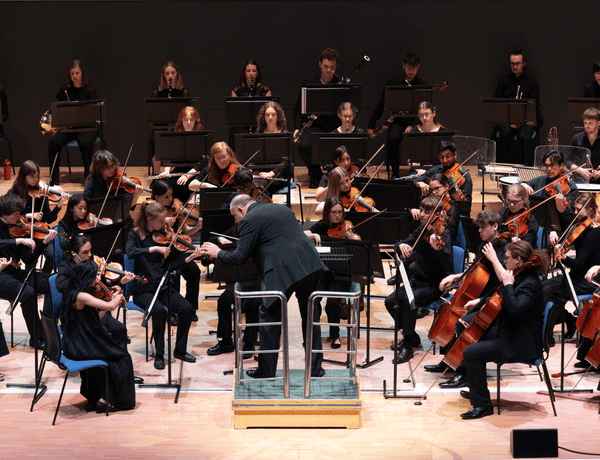
Full programme
- Strauss II, Die Fledermaus (9mins)
- Christopher Churcher, Egress (6mins)
- Brahms, Symphony No.2 (43mins)

Introduction
We begin our concert with the overture to Strauss’ best known stage work, Die Fledermaus. From characterising the dramatised soloistic passages to being taken for a spin on the ballroom floor, we invite you to enjoy a taste of a night at the Viennese Opera.
This concert marks the end of my second year in the CBSO Youth Orchestra and during my time here, I have been met with wonderful opportunities such as being able to perform music by living composers like Christopher Churcher. Inspired by the journey of water from a babbling brook to the great ocean, Egress has a vibrant texture that we are very excited to share with you in this evening’s world premiere! During this week’s course, we were even able to share this piece with the Nanjing Orchestra as part of an exciting cultural exchange.
Brahms’ fantastic Second Symphony is our finale for this concert. Written just after the completion and success of his first symphony, during which Brahms placed himself under a tremendous amount of pressure, this symphony is often described as its ‘sunny counterpart’. Throughout the piece, Brahms masterfully manipulates melodic themes, including one of my favourite passages in the first movement, where he embeds his serene lullaby theme - you may already be familiar with it.
As I sit in the middle of the strings section, I have the pleasure of being surrounded by these gorgeous melodies and I am particularly looking forward to hearing the opening of the second movement as this is one of my favourite sections of the piece.
From the twirling skirts and along the babbling brook, to the symphony's serenity and sublimity, settle in for the journey and enjoy all that these pieces have to offer!
Gabriela Borges da Costa Hofton
CBSO Youth Orchestra Member
Programme notes
The best young musicians in the Midlands take to the Town Hall stage. Members of the CBSO Youth Orchestra enlighten audiences with Brahms' Symphony No.2 in one of Birmingham's most historic venues, alongside a new commission by Christopher Churcher and Strauss II's popular operetta, Die Fledermaus. Brahms wrote to his publisher that for his Symphony No.2 he had ‘never written anything so sad’. His tongue, however, was firmly in his cheek as this is one of his most outrageously cheerful pieces.
Die Fledermaus Overture
Johann Strauss II (1833-1897)
For pure multicultural fun, nothing tops Johann Strauss’s operetta, Die Fledermaus (1874), which makes a perfect opening for today’s celebration. Take an Italian tenor, a Russian prince, a French maid, and a (pretend) Hungarian countess - and just add champagne!
The first notes of the overture could almost be three bottles popping open. The story? It’s a Saturday night in Vienna in the early 1870s. Gabriel von Eisenstein is preparing to spend a week in gaol for insulting a policeman. His wife Rosalinde has caught the eye of an admirer. Eisenstein’s friend Falke is out for revenge, after one of Eisenstein’s drunken pranks left him stuck in the middle of town dressed as a bat (Fledermaus). And an eccentric Russian billionaire is throwing the biggest party Vienna has ever seen. One night brings them all crashing together in a romantic tangle so crazy that all anyone can do is blame it on the Bolly.
© Richard Bratby
Egress
Christopher Churcher (b. 2004)
Egress began life as a short overture titled BREAKWATER, written for the Southbank Sinfonia to mark the opening of the Levinsky Hall in Plymouth in February 2023. The commissioner called for a five-minute concert opener with a thematic connection to Plymouth—a city defined by its deep maritime heritage and the steady presence of the Tamar. From the outset, I was drawn to the image of water: the quiet strength of a river as it meets the restless pull of the sea.
In Egress, the ideas from BREAKWATER are distilled into a fuller, more expansive musical form. The piece reflects the great, paradoxical power of a river—by turns delicate and forceful, poetic and overwhelming—as it rushes toward the ocean. The title, Egress, evokes this sense of departure: the inevitable journey from source to open water, from containment to release.
The music is shaped around two principal motifs. The first is a light, flowing semiquaver figure introduced by the clarinets, suggestive of the flickering play of light on water. In contrast, the brass presents a more weighty, insistent rhythmic motif, embodying the river’s underlying momentum and force. These two ideas evolve and intertwine, driving the piece toward a broad, expansive closing passage—a moment where tension gives way to release, and the music seems to find its own egress into the open expanse beyond.
© Christopher Churcher
Symphony No.2 in D, Op.73
Johannes Brahms (1833-1897)
Allegro non troppo
Adagio non troppo
Allegretto grazioso (Quasi andantino)
Allegro con spirito
Brahms spent two decades writing his First Symphony. As a young man, Schumann had hailed him as the heir to Beethoven - so Brahms, self-critical at the best of times, knew that he had a lot to live up to. It was finally premiered on 4th November 1876. And then, less than a year later, Brahms announced to his astonished friends that he'd finished another. So soon after the First, and written in a fraction of the time - what on earth could it be like? Brahms dropped a few hints shortly before its premiere on 30th December 1877. "Musicians here play my latest in black crape armbands because it sounds so mournful" he wrote not a friend, "and it'll be printed with a black border".
If you know the Symphony you'll already be smiling. For all his seriousness, Brahms loved a leg-pull. This new Symphony was the sunniest and most serene major work he'd ever put in front of an astonished public. The stormy-browed titan of the First Symphony had now, it seemed, made a Symphony of waltzes, lullabies and glowing colours. Everything about it breathed relaxation, and some listeners dubbed it Brahms' Pastoral symphony. He spotlights the rustic sounds of horns, clarinets and cellos, and includes a third movement whose lilting oboe solo sounds like a shepherd's pipe.
But this is definitely Brahms' Pastoral, not Beethoven's. Beethoven's is in F major - a clear, bright key, and his symphony is brisk and springlike. D major, Brahms' choice, is traditionally a mellow key of warmth and celebration - so, put one way, Brahms' symphony feels like a golden late-August afternoon against Beethoven's bright May morning. That could hardly be the whole story, of course - a composer who's just spent most of his adult life learning how to write a true classical symphony doesn't suddenly forget those lessons. Opening with a rumble in the basses and a tender horn call, it's a good few bars before the violins sail in with a serene, singing theme and the movement starts to stir. It feels like Brahms is simply gathering breath.
But listen carefully - the four low notes that are the very first things you hear appear again and again throughout the symphony, tying the argument together. The lovely melody for cellos and horns a few moments into the first movement might sound like the twin of Brahms' famous Lullaby; but it's also the "second subject" of this classically-structured movement. And the second movement, rich and dark, really is Brahms at his most eloquently serious. He knew that sunshine alone can express nothing without shade. Vintage wine from fine old kegs: this Adagio pours its wisdom sweet and clear.
But still - the Second Symphony really was the very last thing anyone expected from the composer of the First. Anyone, that is, except Brahms, who throughout his career followed passionate, hard-fought masterpieces with works that seemed the exact opposite. Few composers disciplined themselves as strictly as Brahms.
So when we hear him indulging in long, gorgeous solos for his beloved horn and clarinet, letting fly as exuberantly as he does in the finale, and finally blazing exultantly away with the biggest brass section he ever used - well, it's hard not to feel he's earned the right. As his great supporter, the critic Eduard Hanslick put it: "The Second Symphony extends its warmth to connoisseurs and laymen alike. It belongs to all who long for good music, whether they understand the technicalities or not".
© Richard Bratby