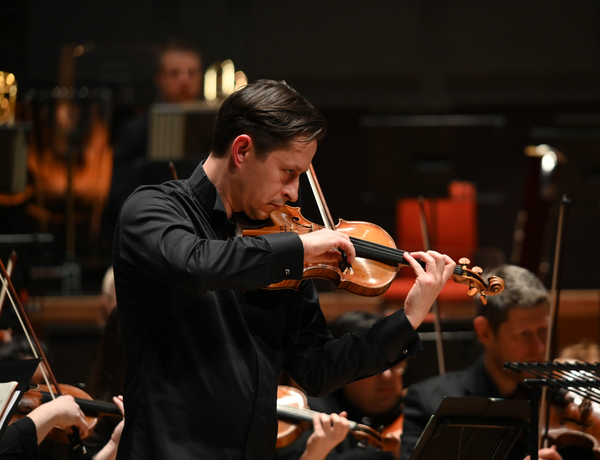
Eugene Tzikindelean plays Mozart
Full programme
- Mozart, Adagio in E major for Violin (8mins)
- Mozart, Violin Concerto No.5 (31mins)
- Mozart, Symphony No.41 (Jupiter) (36mins)
Performers

Introduction
I am greatly looking forward to today’s concert at Birmingham Town Hall. Every concert of this kind is very special to me, but today it is extra special because I wear two hats, so to speak: one as a soloist/director for the first half, and for the second half I trade my violin and bow for the baton. So today marks my debut as a conductor with the CBSO, an opportunity and occasion that I am very thankful for and that I take very seriously.
The opening adagio is a perfect introduction to the afternoon. A calm, beautiful moment, evoking inner harmony - surely one of the more peaceful moments of Mozart’s turbulent life.
The Violin Concerto in A Major was written when Mozart was 19 years old, which seems young for today’s norms but in Mozart terms, it’s the work of a fully mature composer and virtuoso. I first heard Arthur Grumiaux playing this piece when I was a child and I remember thinking that it’s such happy, joyful music. A major is one of those keys that is full of sunshine and vitamins, and this concerto is so distinctively Mozart that it could be used as an “entry” piece to Mozart’s wonderful world.
Playing it without a conductor is a style of interpretation that I greatly enjoy and is how the piece would have been performed at its time of composition. It requires a new level of awareness within the orchestra; everybody is actively listening, phrasing together and supporting the solo part. I personally find it a much more freeing style to make music with my friends and colleagues, and honestly, with the extraordinary musicianship of the CBSO, I am in the best of hands. The challenge of leading a concerto in this way is to keep the transparency and the natural pace of the music. Our mission today is to play so fresh, so lively and organise our expressivity so clearly that even if you’ve heard the piece many times, it must feel like you’re hearing it for the first time.
For the second half I am bringing along my travel companion, my best friend and confidant, the baton. A natural extension from the leader’s seat, conducting is something that not only makes me very happy and liberated, but also for the past many years has pushed me to dig deeper into the music, trying to understand the feelings and thoughts of composers. Conducting allows me also to nourish the particularities of every section in the orchestra and just as a leader does, bring everyone together to present Mozart’s creative genius in the best way possible.
Mozart’s last: the Jupiter Symphony needs no introduction apart from that it reminds us of the very clear reason why music is used as a form of therapy. So just let go of your thoughts and worries and let yourself be mesmerized by Mozart’s finest.
Eugene Tzikindelean
Play/Direct
Programme Notes
If you’re in need of a wholesome mood boost this concert will provide: it’s like sparkling kombucha in concert form. Eugene Tzikindelean leads and takes the solo role in a programme of Mozart at his most sublime – and most productive. Mozart not only composed his fifth violin concerto aged only nineteen, but it was the fifth he had written within nine months. It travels from elegant opener, to graceful slow movement, to a few surprises in the finale. Thirteen years later, Mozart wrote his final three symphonies in only two months. The last, No.41, is so energetic and cheerful you’ll be heading home with a spring in your step.
Adagio in E major for violin
Wolfgang Amadeus Mozart (1756 –1791)
Even more than composition, violin-playing was the Mozart family business. In the year of Wolfgang's birth, his father Leopold had published his Elementary Violin-School - the definitive 18th-century violin textbook – and it was a goldmine of advice for the aspiring violinist-composer. Leopold insisted that true musicianship demanded “great insight into the whole art of musical composition and the differences in style.” It could be acquired, he added, only from “sound judgement and long experience”. For Wolfgang, these were words to live by, and in later life he prided himself on writing music that fitted the skills and personality of its performer (in his own words) “like a well-tailored suit”.
So when, some time between late 1775 and the autumn of 1776, their Salzburg colleague Antonio Brunetti attempted to play Mozart’s Fifth Violin Concerto, and found the slow movement (or so he told Leopold) “too stiff” for his fingers, Wolfgang simply sat down and wrote him a bespoke replacement. We don’t know much about Brunetti, but the Mozarts knew him well; possibly too well. He was in his early 20s, Italian and - to put it mildly - a bit of a lad. His wife was very obviously pregnant when they married in 1778, to the appalled fascination of the gossip-loving Mozart family. Wolfgang later referred to him as “filthy”, but he respected Brunetti’s artistry. And with its courtly opening gestures and graceful, blossoming violin melody, the replacement Adagio that he composed for him could hardly be more presentable.
Violin Concerto No.5
In November 1770, two months before his 15th birthday, Wolfgang Amadeus Mozart was appointed leader of the Salzburg Court Orchestra. He already knew exactly how to get the best out of a violin, and as Leopold Mozart’s son and pupil, his own playing was a source of genuine pride to him. In 1777 he wrote to his father from Augsburg that he'd performed one of his own concertos and "it went like oil. Everyone praised my beautiful pure tone". "It went like oil" – he always had a way with words, as well as notes. He’d called a favourite childhood fiddle his "butter violin", because of its soft, mellow sound.
But there was never much chance that a teenager as ambitious as Wolfgang would confine himself merely to playing the violin, either. His creative genius was so fertile that it seemed to grow from one work to the next; and when he wrote a series of similar pieces in close succession, it's like watching the musical equivalent of timelapse photography. On 14th April 1775, in Salzburg, he finished his First Violin Concerto, and on June 12th, his Second - concise, polished works in a fashionable style, probably meant for Antonio Brunetti. On 12 September he signed off his Third, followed next month by the Fourth.
These are on another level of inspiration – and by now, the 19-year old composer had gone as far with the violin concerto as many composers went in a lifetime. So with his Fifth Violin Concerto, completed five days before Christmas, he ditched the conventions and wrote exactly as he pleased. Take the opening. In a well-bred classical concerto, the orchestra should introduce a variety of melodies, stop, and then hand those same themes politely over to the soloist. Mozart begins with a broad opening theme in the up-to-the-minute "Mannheim" style, presents his second theme - then cuts away to reveal the soloist, as if from afar, playing in a completely different style and speed. And when the violin picks up its cue and gets on with the movement, it's with a wholly new melody - to which that broad opening tune turns out simply to have been the accompaniment!
A technicality, true, but it’s worth mentioning because Mozart's style is so effortless is that it's easy to miss what he's actually up to. And after the serene, tenderly flowing Adagio, the games resume. The finale begins as the courtliest of classical Minuets - then turns, without warning, into a stamping Hungarian dance in (once again) an utterly different style and speed! (18th century Austrians were slightly vague about Eastern European geography; hence the concerto's nickname). And after this astonishing adventure in world music, Mozart slips discreetly back into the Minuet as if nothing had ever happened. A deliciously deadpan end to his teenage fling with violin and orchestra.
Symphony No.41 (Jupiter)
Mozart’s many letters give us a wonderfully colourful picture of his life, apart from one detail - the small matter of writing music. So, when it comes to the summer of 1788, we know that the Mozarts had just moved to a new, cheaper, flat at 28 Währingerstrasse in the Viennese suburb of Alsergrund, that it had a garden and that Mozart was particularly pleased with it. We know that he forgot his sister’s birthday, and what he sent her as a belated gift (some new piano pieces). We also know that he was borrowing money from his brother-Mason Michael Puchberg, and we even know his daily cab fare into the town centre (10 kreuzers). But as for the music he was writing at this time – his last symphonies – he doesn’t even bother to mention it. In a letter of mid-June he mentions a proposed series of concerts at the new Trattnerhof casino; they never came off, but would doubtless have required new symphonies if they had (audiences positively demanded world premieres back then).
But that’s basically it. Barring that possibility, we can only conclude that this extraordinary trilogy of masterpieces seem to have come wholly from within, in the space of about six weeks. We do know that Mozart never called this symphony Jupiter. (The title's a 19th-century marketing-gimmick - it seems to have been coined in Edinburgh in 1819 - though it does prove that music-lovers, even 200 years ago, recognised Mozart's 41st as something special). We can assume that Mozart wrote it for a specific performance - no 18th century composer wrote simply for posterity (least of all a composer as cash-strapped as Mozart). The occasion he had in mind must have been celebratory - it's scored for a bright-sounding orchestra with trumpets and drums, and written in C major, the simplest, clearest and sunniest of keys.
Beyond that, we're left with the music itself. Three flourishes open the Symphony. It's a typical 18th-century trick for silencing a chattering audience - but Mozart uses them, like the portico on a classical building, to set the scale for a spacious and serious opening movement. A tender Andante is ruffled by anxious heartbeats; while the Menuetto - grander than anything then being danced even in Vienna's most aristocratic ballrooms - keeps up classical appearances. And then – the finale. Like the end of some glorious comic opera, Mozart introduces his characters - five short melodies, elegant, noble, playful and humorous - and speeds them through every possible exploit until an extraordinary passage where the music starts to fragment, the harmonies slide away from beneath it and the very musical universe seems, for a terrible moment, to be disintegrating.
At which point, with a graceful gesture, Mozart not only re-establishes order but cheerfully proceeds to fit all five melodies together in one of the most brilliant technical feats in all music - even his. You may not even realise he's doing it, but it's impossible not to feel the sheer joy of creation that sounds through the closing bars. With notes like these, who needs words?
© Richard Bratby
Featured image © Beki Smith