Kazuki conducts The Dream of Gerontius
Full programme
- Elgar, The Dream of Gerontius (95mins)
Performers
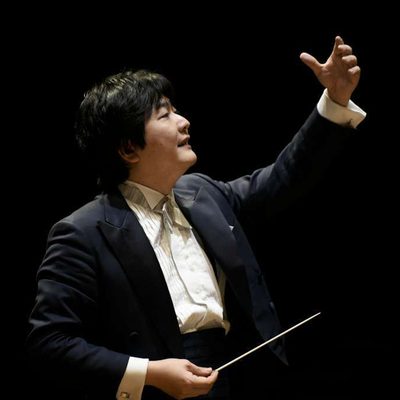
Kazuki Yamada
Conductor
Jess Dandy
Contralto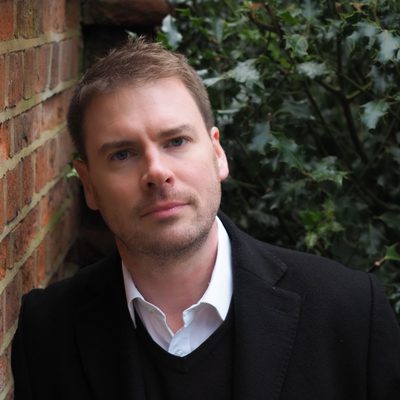
Benjamin Hulett
Tenor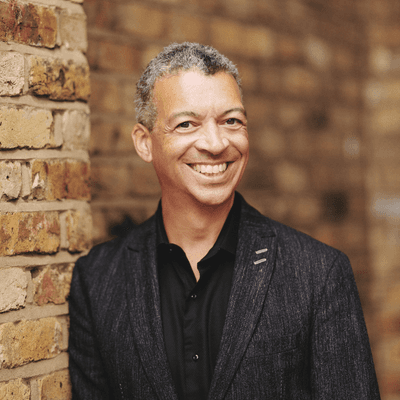
Roderick Williams
Baritone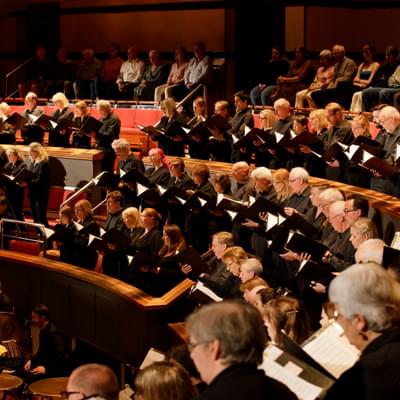
CBSO Chorus
Introduction
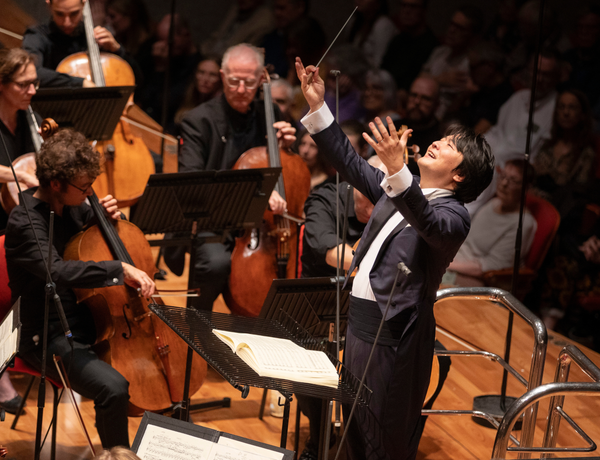
I am really looking forward to tonight’s concert! I have missed the orchestra and audiences over the summer break, so it is wonderful to meet each other again to open the 2025-26 season with Elgar’s The Dream of Gerontius.
This piece was premiered in Birmingham 125 years ago, in 1900, at the Birmingham Music Festival, before the CBSO had even been born. Tonight will be my first time conducting the piece and it feels like such an honour to perform a piece deeply rooted in the city.
The religious background to the story is incredibly fascinating to me. The music presents how we view our life and death and asks the simple question: From where do we go? How are we presented in front
of God?
It is a dramatic story which I find very interesting, especially in the moments where Gerontius is so modestly pleading with God. Elgar wasn’t too well known at the time of its premiere; this was one of his debut pieces but already you begin to see the great elements of his future music foreshadowed in this work.
Do try and listen out for the main leitmotif Elgar uses throughout the piece – it’s a great way to follow the music as you hear the melodic theme return, often changing depending on the scene and the characters on stage, as well as reflecting the shifting emotions.
We perform the work with three fantastic soloists: Jess Dandy, Roderick Williams and Benjamin Hulett. The CBSO Chorus always sound amazing, and I can’t wait to work with them again too – they play an important role in the piece by representing the human connection between the characters. The vocalists also sing in Old English – it has a lot of connections with the German language which I believe adds beautiful depth.
This is a monumental piece by Elgar and I know will make a brilliant start to the season.
Kazuki Yamada
Music Director
Programme Notes
Kazuki Yamada leads the CBSO Chorus and a glorious trio of soloists (Jess Dandy, Benjamin Hulett and Roderick Williams) in Elgar’s profound and touching Dream of Gerontius. It’s very much a homecoming for this mighty oratorio, which was first performed in Birmingham in 1900. It has since become a cherished British work, touching and terrifying by turn and with one of the most beautiful ‘farewells’ in classical music history. Expect to be deeply moved.
The Dream of Gerontius, Op.38
Edward Elgar (1857-1934)
The Dream
Gerontius is old and sick; he may even be dying. As he lies suffering, he’s tormented by fear as well as pain, and he grasps desperately at his religious faith, muttering long-remembered prayers. Friends and loved ones gather around him, praying; and as he slips into unconsciousness a priest bids him farewell. There is silence. And then…Gerontius awakes, somehow refreshed – “as I were at length myself / And ne’er had been before”. He senses that he is not alone; that a being of unbounded wisdom and compassion is watching over him. And as he listens to its song, he begins a new journey, into mysteries so beautiful - and terrible - that words alone are powerless to describe them.
That didn’t prevent John Henry Newman’s poem The Dream of Gerontius from becoming a bestseller upon its publication in 1864. In a century of fast-moving social and technological change, spiritual questions had taken on a fierce urgency and Newman – the theologian, poet and priest whose high-profile conversion to Roman Catholicism had been the sensation of the age – was uniquely placed to answer them. Catholics had been denied full civil rights in the UK as recently as 1829, and many tenets of the faith seemed alien and confusing to English-speaking converts. Newman set out to explain them in poetry, using glowing words and emotionally-charged images to speak directly to his readers. When, in 1879, he was made a Cardinal, he took as his motto Cor ad Cor loquitur – “Heart speaks to heart”.
Newman’s words certainly spoke to the heart of Edward Elgar. As a Catholic and a Midlander, Elgar was intensely aware of the Oratory on Hagley Road in Birmingham that Newman had founded in 1849, and (later) Newman’s burial at Rednal in the Lickey Hills. He had owned a copy of The Dream of Gerontius since at least 1885 (he received another as a wedding present in 1889), and made copious notes, with a view to a musical setting. Elgar wasn’t alone: in 1888, the committee of the Birmingham Triennial Festival had suggested to Antonín Dvořák that he might like to set The Dream of Gerontius to music (Dvořák composed a Requiem instead). So at New Year 1900, when they approached Elgar with the same idea, he was already primed to respond, and on 12 January he visited the Oratory to ask permission to abridge the poem. The Festival would take place in October that year.
The Wind Among the Pines
Elgar worked at fever-heat in his rented cottage at Birchwood Lodge near Storridge – trimming Newman’s verses, and picking out the passages that moved him most powerfully. And then came the music. “Throughout the early months of 1900 we simply lived Gerontius” recalled his violin pupil Rosa Burley. “We talked of little else on our walks and Edward seemed to think of nothing else”. As work progressed, Elgar sent excerpts to his editor Augustus Jaeger in London – his most trusted musical friend, whom he had immortalised as Nimrod in the Enigma Variations the previous year. “I am half undone” exclaimed Jaeger, after studying the score. “Those poignant melodies, those beautiful heart-piercing harmonies!”
Jaeger sensed that Elgar was opening a new chapter: a work that drew on all his reserves of faith and imagination, as well as a deep knowledge of Wagner and decades of experience writing large-scale choral music. This was a long way from the kind of solid, respectable oratorio that had dominated the Triennial Festival since the premiere of Mendelssohn’s Elijah in 1846. It’s more personal (and infinitely more passionate) than that: a spiritual drama rather than an act of worship. Gerontius, said Elgar to Jaeger, is “a man like us, not a Priest or a Saint, but a sinner, a repentant one of course but still no end a worldly man in his life, and now brought to book. Therefore I’ve not filled his part with Church tunes and rubbish but a good, healthy full-blooded Romantic, remembered worldliness”.
And something more than that, too. For Gerontius, the singing of the heavenly hosts is like “the summer wind, among the lofty pines”. Elgar used a large orchestra and his vision of heaven glows with a light, and an atmosphere, that will be recognisable to anyone who has stood on a summer evening and looked westward from the Malverns, the Lickeys or the Clent Hills. Yet still, Jaeger urged him higher. At the climax of the whole drama, as Gerontius’s soul approaches the seat of Judgement, Elgar initially declined to portray the actual presence of the Almighty. Jaeger pleaded, cajoled, and finally taunted him into meeting the challenge: “It wanted a Wagner or a R.Strauss to do that, nobody else would dare attempt it”.
Without a word, Elgar returned to the nearly-completed manuscript and added the blinding flash of sound that no-one who hears The Dream of Gerontius ever forgets. On 3 August 1900 he signed and dated the completed score, with the dedication A.M.D.G. (To the greater glory of God). The premiere was set for the morning of Wednesday 3 October, in Birmingham Town Hall.
The Best of Me
To say that the first performance disappointed Elgar is an understatement. Many reasons have been ascribed: a late change in chorus-master, an impossibly busy rehearsal schedule (normal for the Triennial Festival); the simple fact that the newly-printed scores were full of errors – and that even today, eight weeks would be a dangerously short rehearsal period to learn a new work as complex as The Dream of Gerontius. It’s also true that Elgar was a born pessimist, prone to mood-swings. “As far as I’m concerned music in England is dead” he complained, bitterly, as the disappointment sank in. A more general readiness to think the worst of Birmingham – then, as now – explains much subsequent commentary.
In fact, by most standards the premiere was a triumph – with a cheering audience and critics who, overwhelmingly, saw past the choral mishaps to hail the birth of a masterpiece. “This has been a great day, for it has witnessed the production of a remarkable work” wrote one critic, adding that “there can be no doubt of this, that it is the most powerful and profound utterance of one of the most individual composers”. Within months, The Dream of Gerontius was being performed across the English-speaking world and even - as Der Traume des Gerontius - in Germany where (after a performance in Dusseldorf in May 1902) Germany’s greatest living composer Richard Strauss led a toast to “the first English progressive, Meister Edward Elgar”.
Elgar lived to see The Dream of Gerontius become a classic, and it was performed at his memorial service in Worcester Cathedral in 1934 – though he was actually laid to rest some miles away in the quiet Catholic churchyard at Little Malvern. By then, it was a rare music-lover who would have disagreed with the words (by John Ruskin) that Elgar inscribed on the finished score, that day at Birchwood in the late summer of 1900:
"This is the best of me; for the rest, I ate, and drank, and slept, loved and hated, like another: my life was as the vapour and is not; but this I saw and knew; this, if anything of mine, is worth your memory."
© Richard Bratby
Featured image © Andew Fox