Korngold & Prokofiev
Full programme
- Iman Habibi, Zhiân (10mins)
- Korngold, Violin Concerto (23mins)
- Prokofiev, Symphony No.5 (46mins)
Performers
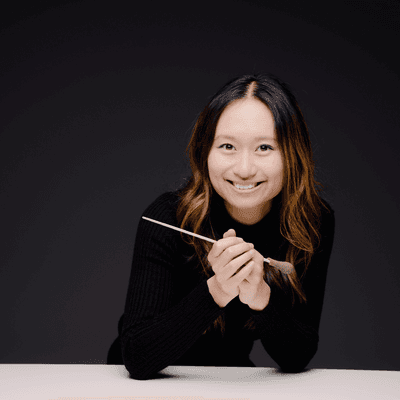
Tianyi Lu
Conductor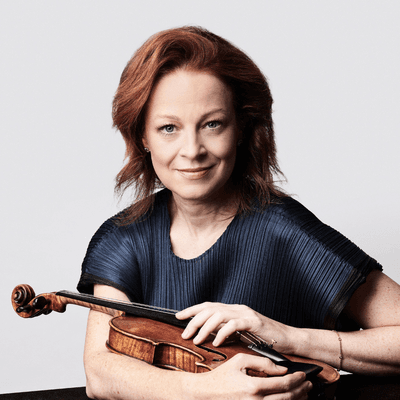
Carolin Widmann
Violin
Introduction
Iranian-Canadian composer Iman Habibi wrote Zhiân in 2023 in response to the protests following the death of Mahsa Amini, dedicating the work to the “Brave People of Iran.” The title means “life” in Kurdish and “indignant” or “formidable” in Persian. For me, the work embodies courage, resilience, and hope.
Hope was undoubtedly one of the many emotions felt during the 1947 premiere of Sergei Prokofiev’s Symphony No.5, when the performance was briefly interrupted by celebratory cannon fire as Soviet forces crossed into Nazi Germany. The work, which in Prokofiev’s words praises “the free and happy human being – of such a person’s strength, generosity and purity of soul,” has all of the composer’s signature qualities: harmonic daring, acerbic wit, bold orchestration and rhythmic vitality. The devastatingly beautiful third movement, with its soaring, almost disorientating lyricism and terrifying orchestral ‘scream’ at its apex seems to me to encapsulate the complex, often fraught political situation at the time.
Korngold’s Violin Concerto, written only a few years before, was criticised as being backward and decadent during a time when serialism and atonality dominated musical discourse. Yet its luminous orchestration and emotional depth reveal a composer who truly believed in his own voice. In an unpublished statement to the press, Korngold asked: “Is there still a place and a chance for music with expression and feeling…music conceived in the heart and not constructed on paper?” Music from the heart – it’s no wonder this work has become a staple in the violin concerto repertoire, and it is a delight to welcome Carolin Widmann to perform it with us.
Each work this afternoon is daring in its own way, and reminds us not only to be true to ourselves, but to listen attentively to the truth within one another.
Tianyi Lu
Conductor
Programme notes
This programme invites you to encounter the darkness of the world, but also to journey to the light. Habibi’s Zhiân was written in response to state brutality in Iran, yet the music is determined ‘to continue striving towards a … vibrant future’. Korngold, veteran of some of Hollywood’s best film scores, poured his experience into this swooningly gorgeous violin concerto written in 1945, and performed here by the brilliant Carolin Widmann. In 1944 Prokofiev returned to war-ravaged Russia to compose his mighty Symphony No.5. Tianyi Lu leads the CBSO in this epic discovery of, as Prokofiev put it, ‘the greatness of the human soul’.
Zhiân
Iman Habibi (b. 1985)
In describing his orchestral piece Zhiân (2023) Iranian composer Iman Habibi notes that while ‘Zhiân’ means ‘Life’ in Kurdish, it can also translate to ‘indignant’ or ‘formidable’ in Persian. The piece was written in response to the suffering of Habibi’s fellow Iranians, whose protests against their repressive government gathered momentum following the death in police custody of a young woman, Mahsa Amini, in 2022. Habibi notes that the protestors’ motto was ‘Zhen, Zhiân, Âzâdi’ (Woman, Life, Freedom), the rhythm of which forms the basis of this orchestral work. The huge walls of sound in Zhiân are intended encourage both a sense of the size of the protest movement, but also to invite those involved – orchestra as well as audience – to join in solidarity with them. The ‘formidable’ nature of the piece is certainly powerfully expressed. Yet the perhaps more optimistic, or at least hopeful, associations of ‘Life’ are present in the regular rhythm – the protestors’ motto – as well as in the well-placed moments of lyricism, which periodically emerge, as if in defiance, from the surrounding discord. There is even room for vulnerability, where the orchestral forces thin out, such as an oboe solo heard below a shimmering cloud of high strings. It is a compelling, increasingly urgent work, yet one which suggests faith that ‘Zhiân’ will continue.
Violin Concerto
Erich Wolfgang Korngold (1897-1957)
Korngold’s compositional career fell into, roughly, four parts. He was a prodigiously gifted child, admired by luminaries such as Mahler and Strauss, and with works performed at the Vienna Court Opera even before his teens. He emerged as a mature writer of chamber works and particularly of operas. Then, in 1930s Hollywood came calling, and he became a popular film composer with scores for Captain Blood and The Adventures of Robin Hood (both vehicles for the swashbuckling star Errol Flynn) among many others. As a Jewish man, he found himself cut off in the US after the Anschluss (the annexation of Austria by the Nazis in 1938) and he continued to work for the studios. After the war, he embarked on his fourth and final phase: a return to the concert hall. His Violin Concerto in D major was written in 1945 and – as was Korngold’s habit – involved some recycling: each movement borrows material from at least one film score, and there is more than a touch of ‘Hollywood’ about the piece, both in its high romance and in its high-spirited – swashbuckling, even – energy in the finale.
The opening theme is an expansive rising and falling melody, gracefully ornamented. The second theme is, if anything, even more opulent. Indeed, there is overall an air of luxury about this work, but particularly so in the first movement, with full-blooded variations on the main themes, and a powerful cadenza. The close of the movement appears to channel the dark romanticism of Sibelius’s Violin Concerto; but ultimately the Concerto is tender rather than agonised. The glistening strings and winds which bolster the soloist’s final ascent produces a simply sublime effect. The slow movement is lyrical, but pared back – and with a touch of melancholy, even mystery in its central section. Always creative in his use of percussion, Korngold makes great use of the vibraphone here, an instrument he had encountered in his film-music years. The folk-like finale is riotously good fun, played across a series of vigorous dances, including some spirited commentary from solo orchestral instruments, such as the rippling scales on the celeste. The sumptuousness of this concerto was somewhat out of step with the increasingly austere and sometimes jagged-edged music emerging after the War, but since the revival of interest in Korngold some decades later, has very much found its place in the regular concert repertoire.
Symphony no.5
Sergei Prokofiev (1891-1953)
Prokofiev’s Symphony No.5 was composed in 1944, in a composer’s retreat northeast of Moscow, where composers were permitted to work away from the war-blasted main cities. It came at the end of something of a golden period in Prokofiev’s life. He had returned to Russia in 1933 after sojourns in the US and Europe, and wrote some of his most enduringly popular compositions in this period, including his ballet Romeo and Juliet and the children’s work Peter and the Wolf. Symphony No.5 was also hugely successful at both its Russian and US premieres in 1945. But it was to be his last big hit. He was becoming increasingly ill, and the situation for composers in Russia was about to get very bleak indeed. The politician Andrey Zhdanov, promoted by Stalin to lead cultural policy, clamped down on all forms of artistic expression considered to be ‘anti-Soviet’. Prokofiev’s music became, effectively, banned along with that of many of his fellow composers, until the death of Stalin on 3 March 1953: the same day that Prokofiev himself died. His final symphony can, then, be retrospectively imbued with even more urgency and personal expression than even the composer intended at the time. Prokofiev did feel, however, that it was saying something profound back in 1944. Somewhat given to grand statements about his own work, he wrote of the Symphony that it was ‘very important not only for the musical material that went into it, but also because I was returning to the symphonic form after a break of 16 years… I conceived of it as a symphony on the greatness of the human soul.’ Big words: but Prokofiev more than backs himself up with this very Big Symphony.
It opens with a slow, rather pastoral theme for woodwind, the bucolic nature of which is undercut by gravelly double basses and contra-bassoon. The theme expands into the strings, yet remains at odds with its ominous backdrop. This is the mood, generally, of the opening movement: contrasting moods, sometimes rapidly alternating, of calm versus frenetic, or expansive versus tightly-wound. The last minute of the movement surges from a lyrical cello solo, to a vulgar ‘raspberry’ of a chord, then a final, blistering jangle for the whole ensemble, which could sound celebratory, or alarming, or a weird combination of both.
There is a ‘perpetual motion’ feel to the second movement, channelling the relentless energy of some of Prokofiev’s earlier works, such as his fiendish Piano Concerto No.2. The central section is lighter, even comic, with more good-natured bustle than frenzy, and even a touch of jazz. But the composer’s characteristic ‘edge’ returns with the material from the opening of this movement. Snarky brass and plucked strings collectively portray a gathering sense of menace as they gradually speed up. The movement concludes with a breathless gallop to a final, sudden stop.
The third movement is rich, sombre, lush, lonely, warmly expressive and heart-breakingly anguished – either by turn or, somehow, all at once. The opening theme is lyrical, yet even within a few bars is clashing rhythmically with its accompaniment, which is a kind of curdled version of the arpeggios in Beethoven’s ‘Moonlight Sonata’. A solo piano figure intrudes, bringing with it more intensity, and further forays into dissonant territory. The tempo increases, along with the savagery of the brass interjections and the high-pitched ‘screams’ of the strings and woodwind. The return of the opening theme, over the swaying ‘moonlight’ figure is extraordinary, transformed by the intervening turbulence into something remarkably poignant. The music eventually melts into a sweet, surprising, major chord.
This sweetness carries into the finale, but only initially. What follows is another classic Prokofiev ‘motor’: a brisk, spiky melody over a chugging accompaniment; dance-like, yet a dance which threatens to spiral out of control. There is wit here, but it is often of a caustic nature. The end of the movement is brilliantly unhinged. If Prokofiev intended to convey something profound about the ‘greatness of the human soul’ here, perhaps it is the very human ability to embrace everything: the grotesque, the wild and the utterly carnivalesque.
© Lucy Walker
Farewell and Thank You, David Powell
This evening’s concert is David Powell’s last as sub-principal cello of the CBSO. After 45 years of dedicated service, we in the cello section are very sad to see him go, but also celebrate his achievements as a committed member of the orchestra.
Appointed in 1981 by Sir Simon Rattle, David has sat in a pivotal position towards the front of the cello section, supportive of those in front of him and clearly communicative to those behind, so that the whole section is unified in sound and musical direction.
As well as keeping his own playing standards at the highest level for such a long time, David lives and breathes music and the cello. He has shown unwavering enthusiasm for pieces he must have played hundreds of times and embarks on each project as though it’s his first. As well as his love of orchestral music, he has been a committed chamber musician, performing regularly in the Centre Stage series as a member of the Dadelsen Piano Trio, the Montpellier String Trio and with other ensembles.
His keen interest and knowledge of cellos has been invaluable to his colleagues. He is quick to notice a new instrument or bow being tried in the section and gives his expert opinion honestly and concisely.
David’s infectious sense of humour has been a joy for us all and if sitting behind him, one would know something amusing had just happened. His shoulders would start to gently shake and continue to do so until hysteria would spread around the section.
A passionate and committed teacher, notably at Nottingham University for 11 years, he has been able to pass on his vast wisdom and experience to the next generation. In similar fashion, as a member of the Artistic Think Tank, the Players Committee and as Chair of the Benevolent Fund, he has always been generous in passing on his extensive knowledge to his successors. Before turning to the music profession for a career, he studied Law at Oxford University and many colleagues have remarked that his skills in this field have been invaluable when negotiating and finding common ground in tricky situations.
Above all, throughout his time in the orchestra his warm personality and inclusivity have shone through. His kindness and encouragement to all, rooted in his Christian values, have been constants in his long and distinguished career.
A True Gentleman.
Words by Kate Setterfield, sub-principal cello.
Featured image © Andrew Fox