Nielsen's Fourth Symphony
Full programme
- Adrian Sutton, War Horse Orchestral Suite (15mins)
- Adrian Sutton, Concerto for Violin and Orchestra (26mins)
- Nielsen, Symphony No.4 (36mins)
Performers
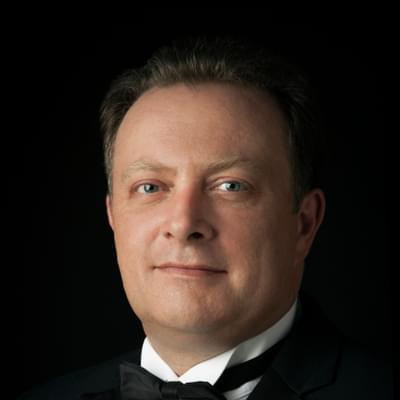
Michael Seal
Conductor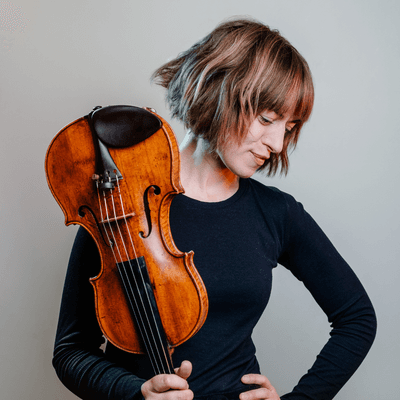
Fenella Humphreys
Violin
Introduction
I grew up listening to the incredible recordings of the CBSO and I’m properly excited to perform with the orchestra for the first time tonight.
The first half of the programme is a celebration of music by composer Adrian Sutton. He’s best known for his National Theatre scores such as the brilliant suite from War Horse that opens tonight’s programme. But Adrian’s equally passionate about his concert music.
We first worked together just over 10 years ago when I asked Adrian to write one of the first pieces I commissioned. I love working with living composers. Being part of the creation of a work, able to talk with the composer about the notes on the page, to have something written with your playing and voice in mind - it’s the most special thing. Especially with a composer who has become a close friend and knows your playing as well as anyone could.
Adrian had talked regularly about writing his violin concerto from our very first conversations, but it never quite happened. When he was diagnosed with incurable cancer in 2022, he decided this was the music he had to compose while he had the chance. Often written during his chemotherapy sessions and inspired by the images in Richard Bach’s novel Jonathan Livingston Seagull, the original plan was a short work for violin and orchestra. The music had other ideas though, and eventually one day Adrian sent me a message saying it had taken on a life of its own and maybe he was going to have to call it a concerto after all.
The work is a gull’s-eye view of the vast ocean, feeling as close to flying as seems possible on a violin. The movements are titled ’Thermals’, ‘Far Cliffs’ and ‘Life Force’, and the beautifully crafted writing is full of virtuosity, emotion, colour and sublime line. The lush music is suffused with positivity throughout, and towards the end a trumpet fanfare appears that’s one of the most joyful moments I’ve experienced on stage.
I hope you enjoy this gorgeous music tonight as much as I love performing it.
Fenella Humphreys
Violin
Programme Notes
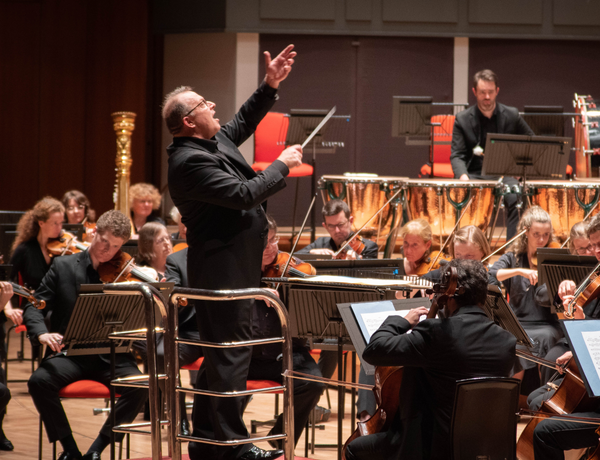
Nielsen’s Symphony was written in the early years of World War I. It struggles, sometimes dances, sometimes falls – but ultimately survives. Another survivor is Joey, the ‘War Horse’: Sutton’s score is as moving as the heart-stirring stage show. More recently Sutton composed his uplifting Concerto for Violin during an exhausting round of chemotherapy. It was written for the extraordinary talent of Fenella Humphreys. Michael Seal leads the CBSO through these stirring stories. Music is, indeed, life.
War Horse Orchestral Suite
Adrian Sutton (b. 1967)
Michael Morpurgo’s War Horse relates the tale of Joey, a horse sold to the cavalry in World War I, and his relationship with his owner’s son, Albert. It was originally a novel, published in 1982, then a hit play in 2007 at the National Theatre, and later a film directed by Steven Spielberg. Adrian Sutton’s original music was a vital element of the emotional heft of the play. This Orchestral Suite, compiled in 2023, drops in on the principal beats of the drama: from idyllic, bucolic opening and the bonding of Joey and Albert, to the terror of war, and to the eventual, poignant reunion between boy and horse.
Sutton consciously drew on English, folk-imbued orchestral works of the era just before and during WWI. We might be reminded of Vaughan Williams, or perhaps Finzi. This pastoral backdrop, along with references to popular tunes of the day, represents ‘home’, specifically Devon, and the life that Joey and Albert had before 1914. Nostalgia is therefore both an element of the score and a suggestion of what will be remembered in the future; the music also foreshadows the horror and disruption of what is to come. The opening movement, for example, features Joey’s own theme, a military fanfare, followed by the folksong ‘Only Remembered’ (‘Thus shall we pass from this earth and its toiling/Only remembered for what we have done’).
Another military tune, ‘The Scarlet and the Blue’, appears as a motif throughout. In the play, it is sung early on with boisterous good humour, as the volunteer soldiers sign up for service in anticipation of a great ‘adventure’. Yet in ‘Crossing the Channel ‘, after an edgy opening passage for strings, the song is mournfully echoed on the trombones; and later, in ‘The Charge’, the rhythms of the same tune underpin a sinister, scrambling figure in the strings and a piercing version of Joey’s fanfare. This in turn calls back to the second movement, and the breathless excitement of Albert’s first gallop with Joey. The ‘Englishness’ of much of the music is deliberately contrasted with the European influences in the fourth movement, which depicts the young girl who cares for Joey in France. Sensuous harmonies and translucent orchestration create an entirely different musical world here. At the conclusion of the suite, ‘Only remembered’ returns on the clarinet, similar in mood to the opening movement, but profoundly moving in the context of what has come before.
Concerto for Violin and Orchestra
Adrian Sutton
Sutton’s Concerto for Violin and Orchestra (2023) is a stirring and lyrical work, by turn meditative and exhilarating, with even a touch of the mystical about it. It is a portrait of a gull and the trajectory of its flight, directly linked (inspirationally) with Vaughan Williams’ famous The Lark Ascending – though, as Sutton put it, ‘while the latter is about a bird over land, this piece is about a bird over the ocean’. Sharing the skyscape is another influential bird: Jonathan Livinsgton Seagull, Richard Bach’s cult 1972 novella about a seagull who achieves spiritual enlightenment through the transcendence of flying ever higher. The music channels the romantically inclined concertos of the twentieth century such as those by Britten and Walton, but also – as Jeremy Nicholas has pointed out - the swooning, dreamy style of Korngold, a composer well-known for his 1940s film scores. The wealth of allusion in this Concerto could easily have weighed it down, but this is far from the case. It was composed specifically for Fenella Humphreys, a violinist whose fluid and graceful style is a perfect match for its remarkable lightness and ecstatic reaches into the stratosphere.
The opening movement (‘Thermals’) tracks the progress of the gull, coasting with the thermal currents, punctuated by sudden dives or upward soaring. The sound world is largely the gull’s, given space and time in a lengthy solo cadenza. ‘Far Cliffs’ is serene, and perhaps the most obvious reference to The Lark Ascending. After a somewhat folk-like opening, the violin is irresistibly drawn to the top of its range, periodically abetted by high woodwind and shimmering strings. An anticipatory orchestral figure acts as a springboard for the gull in the opening of ‘Life Force,’ the Concerto’s uplifting finale. The gull exults throughout in the thrill of its own capabilities. It is hard not to be moved by the composer’s own experiences writing this work: undergoing twelve rounds of chemotherapy for the treatment of incurable cancer. Yet as Jon James puts it in relation to the final movement in particular, ‘there is an invitation to hear in the music a reflection of Adrian’s own personality and journey: keeping going despite adversity, celebrating life in the now, seizing the day — and in so doing, finding release’.
Symphony no.4
Carl Nielsen (1865-1931)
Nielsen’s fourth symphony (1914-16) sounds like it was carved from granite, or forged in some mighty, mythical fire. This might seem a stereotypical response to the composer’s Scandinavian roots, but is perhaps not too far from the composer’s intentions. The symphony was subtitled ‘The Inextinguishable’: those worried about being in for a long evening need not worry unduly, the work lasts only around 35 minutes. Rather, Symphony no. 4 represented a kind of mission statement for Nielsen, putting into musical form his thoughts and feelings about what music is. Unlike the other arts, stated Nielsen, music does not depict or describe, but instead embodies the ‘basic emotion’ that underlies human existence: it does not portray life, it is life in all its primal force. Or, as Nielsen put it, a ‘dip right down to the layers of the emotional life that are still half-chaotic and wholly elementary.’
What all this means is, of course, subject to interpretation. But the occasionally unhinged quality of this piece – particularly in its opening bars, and the aggressively duelling timpanis of the finale suggests an atmosphere of barely-contained chaos, or volcanic rage, confronted by forces attempting to reason with it. Apart from a seemingly anchoring passage marked ‘Glorioso’ at the end of the first and fourth movements, the Symphony is in a process of perpetual, sometimes violent evolution.
It opens with a violent outburst, followed by a bewildering melange of themes, flung from all sides of the orchestra. The instrumental forces swell and retract, sometimes into eccentric gatherings, such as a quirky passage for double bass and woodwind, sometimes pulsating with an irresistible internal force, or bursting into a joyful march, or tiptoeing stealthily through the woodwind and upper strings, before being blasted off the stage by the brass. The movement concludes with the ‘Glorioso’ passage, a richly harmonised downward scale which gradually quietens before embarking on a surprisingly demure second movement. Its whimsical, folk-like character, concluding with a ‘cuckoo’ from the clarinets, does nothing to prepare listeners for the animal howl from the strings at the start of the slow movement, punctuated by timpani stabs. While interspersed by more serene moments, this movement is deeply unsettling, with obsessive repetitions and urgent themes, almost operatic in their intensity. The finale gives even further rein to the forces of misrule, culminating in the extraordinary battles of timpanis, instructed by Nielson to play with ‘a certain menacing character’, and which tend to reduce the rest of the orchestra to squeaks of terror. While the Symphony eventually resolves into a shining major key, such has been the disruptive nature of the work - written, lest we forget, in the first two years of World War I – we sense the struggle is far from over. Inextinguishable, indeed.
© Lucy Walker
Featured image © Hannah Fathers