Shostakovich’s Last Symphony
Full programme
- Sibelius, Karelia Suite (14mins)
- Sibelius, Five Songs: Autumn Evening (5mins)
- Sibelius, Eight Songs: Baron Magnus (3mins)
- Sibelius, Seven Runeberg Songs: Spring is Flying (2mins)
- Sibelius, The Bard (6mins)
- Sibelius, Luonnotar (10mins)
- Shostakovich, Symphony No.15 (42mins)
Performers
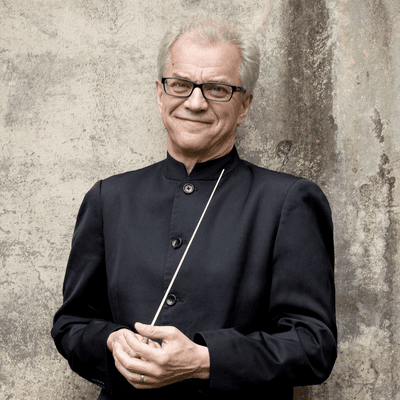
Osmo Vänskä
Conductor
Helena Juntunen
Soprano
Introduction
Sibelius' Karelia Suite is one of his most popular works. Its three movements are taken from a larger 50-minute work called Karelia Music. It was a great pleasure for me to make the first complete recording of the full work in 1997 with my orchestra at the time, Sinfonia Lahti. The process helped me to understand the historical significance of the Karelia region and its impact on Finland's independence in 1917.
I have done this collection of Sibelius songs performed in today’s concert several times with Helena Juntunen. People are often surprised to learn that Sibelius has written vocal music too, not only the wonderful violin concerto. One of my favourite works of these is Luonnotar. It’s a Kalevala version about the creation of the world with a very virtuosic vocal part.
My first experience with Shostakovich’s Symphony No.15 was when I played it myself as a clarinetist with the Helsinki Philharmonic. Until then, my impression of Shostakovich was that most of his music was about desperation and death related to World War II. So, it was a surprise to me to notice while playing how funny and witty Symphony No.15 is. After all, no one can help but smile when hearing a quote from Rossini's William Tell Overture!
I am greatly looking forward to working with the City of Birmingham Symphony Orchestra for tonight's concert and I hope you too experience the warmth I feel towards this music.
Osmo Vänskä
Conductor
Programme Notes
This programme is a full immersion into the history and magical legends of Finland, led by two outstanding Finnish musicians: conductor Osmo Vänskä and soprano Helena Juntunen. They invite you to travel to the origins of the earth with the goddess Luonnotar, hear folk tales from The Bard and celebrate with the people of Karelia (a region now split between Finland and Russia). We head further east to Russia for the final piece: Shostakovich’s last Symphony, begun in a hospital bed and bursting with memories of his profoundly musical life.
Jean Sibelius (1865-1957)
Karelia Suite
In 1893 Sibelius was commissioned by a group of university students to write incidental music for an ambitious historical tableau about Karelia (covering the period 1293-1811). Geo-politically, this region has been much disputed between Finland, Sweden and Russia but in 1812 the areas previously occupied by other countries were formally incorporated into the Grand Duchy of Finland. (The region is today split between Russia and Finland, following further twentieth century conflicts.) All of which preamble is to set the scene for the nationalist impulse behind the original commission, Sibelius’s heartfelt response to it, and the rowdy and enthusiastic reception it received at its premiere. The Suite comprises three movements extracted from the much larger ‘Karelia Music’.
The opening ‘Intermezzo’ depicts the rising up of Karelians against Lithuanian oppressors, opening with a rallying call and building to a rousing march. The poignant ‘Ballade’ movement is based on Karelian folksong, while the ‘Alla marcia’ is a splendidly singable and triumphant conclusion. Sibelius, who conducted the premiere, reported that his music could barely be heard above the noisy enthusiasm of the audience. ‘You couldn't hear a single note of the music’ he wrote to his brother. ‘everyone was on their feet cheering and clapping.’
Five Songs: Autumn Evening
The first song in Sibelius’s Five Songs, known as Höstkväll in Swedish, was premiered by the soprano Aïno Ackté, for whose formidable talents Sibelius also composed Luonnotar. She must have had quite a vocal range, as well as the expressive and dynamic heft to tackle the demands of Höstkväll which is considered one of Sibelius’s finest songs. The autumnal text is not one of crackling fires and crunching gaily through fallen leaves, but a heady, deeply Scandinavian mix of desolate landscapes, the lonely cries of birds, and a profound melancholy. Sibelius catches its mood beautifully: never overstating the case, but backing the words with an intense and continuous throb of emotion.
Eight Songs: Baron Magnus
A wistful Baron Magnus is the subject of this song, leaning out of his window and wishing for a more magical, less blood-curdling life. An alluring mermaid draws him out of his despair but, unusually for such tales, he isn’t condemned to a watery hereafter, but is found sleeping on a nest of violets. As in his other songs (and they truly deserve to be better known!), Sibelius gives just the right amount of narrative colouring to this enigmatic, dreamlike tale.
Seven Runeberg Songs: Spring is Flying
Sibelius wasn’t known for being a great romantic, so this short, utterly delicious setting is something of a charming outlier. Gently flurrying woodwinds and soft strings accompany the lyrical soprano part, building to an almost outrageously ravishing climax on ‘Låt oss nu blott äska, Låt oss nu blott kyssas’ (Let us love now, let us kiss now).
The Bard
A solo harp takes on a ‘bardic’ role in Sibelius’s 1913 tone poem. While there is no narrative as such attached to this piece, the music conveys a palpable sense of ancient mystery, especially in its opening minutes. The second half is more energetic, yet its surging power is still imbued with the introspective mood of the start. By the end, however, a turn to the major key suggests that some measure of equilibrium has finally been achieved.
Luonnotar
Sibelius’s 1913 tone poem is an elemental work – in a number of senses. Set in a time before the creation of the earth, it concerns Luonnotar who is the daughter of Air; she jumps ship, so to speak, and becomes Mother of the Water. She drifts in the seas for centuries, until, following a storm, her protruding knee becomes the home of a seabird. Its eggs shatter, and the shells form the sky as well as its sun, stars and clouds. Sibelius’ work is one of many evocative orchestral pictures derived from the Kalevala, Finland’s most important collection of folklore. Unusually for one of these ‘tone poems’, Sibelius adds the singing voice to Luonnotar: the soprano narrates Luonnotar’s journey from space to ocean to the creation of the skies, as well as – very poignantly – embodying the seabird seeking a home for its nest. Accompanying her is a surprisingly spare, almost minimalist orchestral texture. Even the storm is delicately drawn rather than typically ‘tempestuous’, simply a rustle of harp and some timpani rumbles. For the seabird, the voice swoops and soars across the orchestra, peaking high in the soprano’s range on ‘Ei, ei, ei’. The momentous creation of the earth finds the music back in the meditative, suspended state of the opening. The Finnish soprano Aïno Ackté, for whom Sibelius wrote the piece, wrote to the composer that ‘it swept me off my feet’. It is assuredly one of Sibelius’ most inspired works, infused with more than a touch of the mystical.
Dmitri Shostakovich (1906-1975)
Symphony no.15
Shostakovich’s last symphony, completed in 1971, is both a valedictory conclusion to a lifetime of orchestral composition, and something of a head-scratcher. The composer was ill in hospital while working on the final draft, and the piece was written in something of a frenzy; indeed, much of it has a hectic, somewhat fragmented feel. The opening movement in particular sometimes sounds like the composer was twiddling a dial on the radio, and periodically finding bursts of nineteenth century opera. Rossini’s William Tell appears over the ‘airwaves’ in the first movement; motifs from Wagner in the finale. William Tell isn’t perhaps as random as it seems, given its principal rhythm had been adopted by Shostakovich as something of a fingerprint in several of his symphonies and other works. But its appearance in its original form still sounds incongruous, poking through the scrambled contemporary texture. Adding into the mix are the strange, spare noises at the Symphony’s conclusion, perhaps resembling – as Tom Service suggests – the electronic sounds of hospital machinery.
After the montage-like opening movement comes the first of two ‘Adagios’. It is a lengthy and searching passage of music, often dismantling itself into chamber-like groups and featuring some striking solos – an anguished outburst for trombone, for example, and a later cameo for vibraphone. It builds eventually to a gigantic wall of sound, in a rare moment of unity for the whole ensemble. But by the final bars, only timpani and stuttering brass remain, as if the orchestra’s batteries are gradually wearing out. The brief Allegretto charges things up again. While less aggressively barbed than some of Shostakovich’s scherzo movements, it maintains the composer’s characteristic ‘edge’ with its curdled violin solos, snarky interjections from wind and muted brass, and haunting, clattering percussion.
The finale opens in a Wagnerian mood: a quote of the ‘fate’ motif from Wagner’s Ring cycle (which appears again later), followed by what promises to be the main theme from Tristan und Isolde, though Shostakovich diverts it after only three notes. The music then bides its time, travelling through a further series of chamber groups, before arriving at a hushed ‘passacaglia’ (a repeated bass line) based on Shostakovich’s own ‘Leningrad’ Symphony. This in turn fades out, in favour of a haunting passage for celeste, horn and strings that appears to unleash a sudden, demonic force: a ferocious and sustained howl for the full orchestra. A drum calls for order, and the final minutes of the Symphony comprise a gradual ‘farewell’. Small ensembles meet, as if in secret; a brief reprise of the ‘fate’ motif heralds a curiously sweet fragment for strings, played as softly as an echo. An eerie percussion ensemble closes out the work. Maybe a ticking clock, maybe a hospital machine – or maybe Shostakovich’s orchestra has been finally, and utterly hollowed out.
© Lucy Walker
Featured image © Andrew Fox